
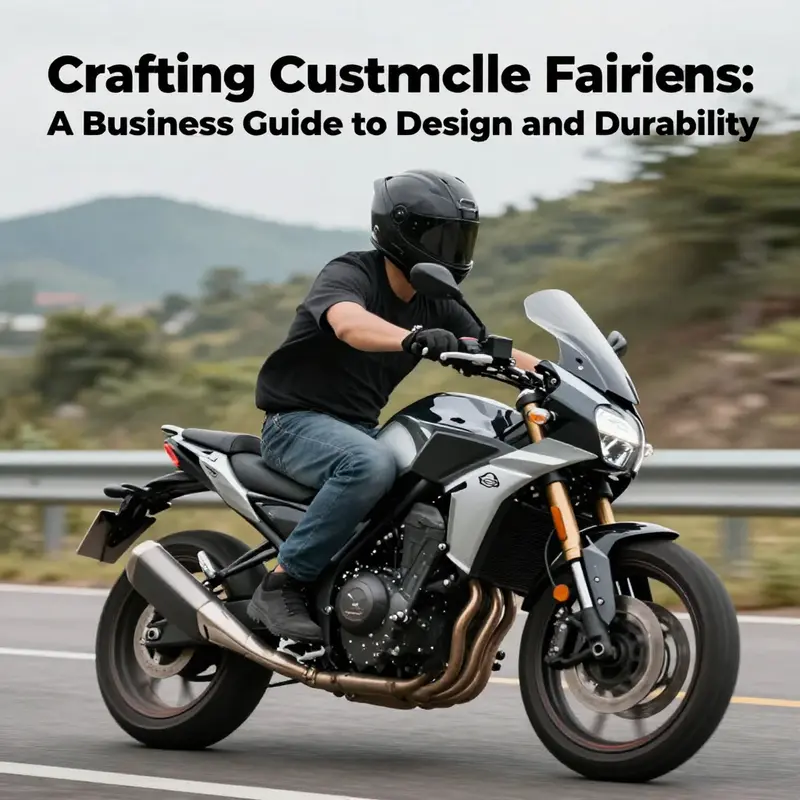
Creating custom motorcycle fairings not only enhances aesthetics but also improves aerodynamics and functionality, presenting an invaluable opportunity for businesses in the motorcycle industry. This DIY project integrates design creativity, engineering principles, and craftsmanship, offering a path to stand out in a competitive market. Each chapter in this article breaks down essential phases of fairing customization, from designing customized models and selecting the best materials to addressing safety and legal considerations. By understanding these areas, business owners can ensure both the quality of their products and compliance with regulations, ultimately delivering exceptional value to their customers.
Molded Velocity: Designing Custom Motorcycle Fairings from Intent to Realization
 Designing custom motorcycle fairings is a fusion of artistry, engineering, and practical fabrication. In this chapter, the goal is to weave a coherent pathway from the rider’s intent to a tangible, ride-ready panel system. It is not merely about making something that looks sharp; it is about shaping an aerodynamic envelope that preserves balance, protects components, and respects the dynamics of real-world riding. The journey begins with understanding why a rider wants a particular fairing in the first place and where the bike will live in the spectrum of performance, comfort, and daily practicality. Touring riders seek wind protection that minimizes fatigue on long miles, sport-oriented riders chase a lighter silhouette that yields improved handling and a more aggressive stance, and urban commuters require compact, resilient forms that shield vital parts without compromising maneuverability. This triad of intent informs every subsequent decision, narrowing the field of options early so that the design can progress with clarity rather than chasing broad aesthetics alone. In practice, this means that the first conversations around a project focus on fit, visibility, and rider posture. A fairing must harmonize with the motorcycle’s frame geometry, the rider’s seating angle, and the rider’s line of sight. It must also respect clearance around the front wheel, fork legs, radiator or cooling avenues, and electrical routing. These are not merely cosmetic considerations. They anchor the engineering discipline behind the project and protect the machine’s behavior at speed. With intent defined, designers turn to digital tools that translate ideas into precise, testable models. Computer-aided design (CAD) software becomes the sandbox where smooth curves meet structural constraints. The software allows the designer to sculpt the fairing volume with an eye toward airflow, but it also enforces practical realities: mounting points, gasket lines, and the accessibility needed for maintenance. Aerodynamics become more than a visual curiosity; they are quantified through simulations that approximate how air flows around the bodywork at representative speeds and angles. A well-conceived model minimizes drag and buffeting while preserving the rider’s comfort window. Yet even the most elegant digital form must connect with the real world. Generating a tactile, testable replica—often in the form of a physical template—bridges the gap between screen and street. A prototype might begin as a high-density foam mock-up or even a 3D-printed shell, chosen for its lightness and flexibility to be shaped, sanded, and adjusted without committing to expensive tooling. This physical model serves multiple roles: it reveals how the twist of a contour affects the rider’s wind experience, it exposes clearances around fixtures and fasteners, and it creates a tangible platform for feedback from test riders and workshop engineers. The transition from prototype to production involves deciding how the final fairing will be manufactured. Material selection lies at the heart of this decision and must be guided by the intended use, weight targets, and cost constraints. For lightweight, performance-oriented applications, fiberglass-reinforced composites, carbon fiber, or reinforced plastics offer a favorable balance of stiffness, impact resistance, and weight savings. ABS and polycarbonate remain viable alternatives when ease of molding, repairability, and affordability take precedence. Each material brings its own behavior under temperature, sun exposure, and road debris. UV stability matters because a fairing in bright sun can suffer from chalking or color fade if not properly protected. Thermal durability matters because the piece will see direct sunlight, road heat, and sometimes engine heat transfer. The choice between a simple hand lay-up and a more sophisticated lamination process depends on the project scale. For low-volume or one-off builds, hand lay-up with fiberglass or carbon-fiber fabrics offers the freedom to sculpt complex shapes without the costs of automation. For higher-end or repeatable pieces, a mold-based approach followed by lamination can yield a consistent, high-quality surface that tolerates fine detail, while allowing for tighter tolerances and repeatability. When planning the production method, it is essential to consider the volume, the required surface finish, and the anticipated durability under typical riding conditions. Injection molding can be efficient for higher volumes, but the upfront tooling investment is substantial and best justified by a clear market. CNC routing or milling is excellent for panels that incorporate aluminum or rigid plastic cores, especially when precise cutouts and mounting interfaces are required. In many custom builds, a hybrid approach emerges. A rider might begin with an injected or machined core for a structural base, then apply a hand-laid outer skin to achieve the texture and finish that mirrors the bike’s character. This path preserves high strength where it matters, while allowing artistry to define the visible surfaces. The sourcing of materials and components enters as a practical counterpoint to the theoretical design. Reliable suppliers are critical when the goal is a part that not only looks good but remains stable through countless miles. The landscape of supply is diverse, with regions that excel in polymer processing, composite materials, and mold-making expertise. In this context, it is prudent to evaluate suppliers not only on material quality and price but also on certifications, process control, and lead times. A thoughtful procurement plan includes quality checks at multiple stages—from raw sheets and fabrics to finished laminates and coatings. As the project advances, testing and refinement become the heartbeat of the work. Wind tunnel testing or computational fluid dynamics feedback can help refine contours that influence drag and buffeting. Real-world testing is equally essential: a test ride reveals how the fairing interacts with wind pressure on the helmet, how it handles at highway speed, and how vibration is transmitted to the rider and the motorcycle frame. Sound, perceived airflow, and gust response are not merely sensory; they reflect whether the fairing truly harmonizes with the bike’s dynamics. Feedback from test riders—ranging from posture comfort to helmet gold-lines on the wind stream—provides a candid adjustment loop. The process is iterative by necessity. Small refinements—such as adjusting a section of the lower edge to improve heat management, or tweaking an intake lip to balance ram pressure at high speed—can cascade into meaningful gains in stability and rider confidence. Along the way, safety and legality remain non-negotiable considerations. Custom fairings, while deeply personal in design, must not compromise structural integrity, ground clearance, or visibility. Mounting hardware must remain secure under gust loads, and any alterations to a bike’s silhouette should avoid interference with essential safety features. The balance between artistry and engineering is not a compromise; it is a disciplined convergence where the rider’s intent, the physics of air, and the reality of manufacturing all speak the same design language. For readers who are curious about the practical corners of this field, the design mindset described here can be linked to broader conversations about fairing development and integration with a motorcycle’s broader systems. If you seek a live catalog of shapes and styles to inform your own exploration, a curated fairing collection can provide context and inspiration while you stay within the bounds of your project’s constraints. For instance, you can explore the Honda fairings collection to observe how form interacts with mounting interfaces and the bike’s overall silhouette, and to consider how a design language travels across a family of bikes. Honda fairings collection can serve as a reference point for evaluating how curves, edge treatments, and panel transitions read at a glance, even as you pursue a truly customized approach that suits your unique riding profile. The point is not to imitate a catalog exactly but to absorb principles about how lines flow, how the surface meets hardware, and how the finished piece communicates the rider’s intentions. In the journey from concept to surface, the most convincing fairings are those that feel inevitable once mounted on the machine. The best designs emerge when every bend or cut aligns with a functional need—protection for the knee, guidance of airflow toward the radiator, or a clean path for wiring and sensors—while also contributing to the bike’s personality. This is where the step-by-step discipline becomes a living practice rather than a rigid recipe. A designer who remains faithful to intent can iterate with confidence, knowing that the essential questions have clear answers: Will the fairing protect vital components? Will it steer air efficiently without causing excessive drag? Will the assembly be maintainable and repairable? Will the finish withstand the sun, rain, and road salt? Will the final appearance reflect the rider’s narrative as well as the machine’s engineering truth? When these questions have strong answers, the design stands up to scrutiny in the wind, the shop, and the road. The overarching story is not about chasing novelty but about articulating a coherent relationship between rider, machine, and environment. The process described here is designed to be adaptable across different bike geometries and riding styles. It accommodates variations in frame width, fork rake, fairing height, and the location of the instrument cluster. It also acknowledges the realities of supply chain volatility and the realities of a one-off build. The goal, in short, is a fairing that feels like a natural extension of the bike and rider, not a bolt-on afterthought. As a rider moves from concept into prototyping, from digital model to cut path and lamination, the eyes stay on the road and the hands stay on the tools. The narrative becomes a shared language between the designer, the fabricator, and the rider. It is a language that values accuracy, but also tolerates the necessary imperfection that comes with human craft. The result is more than a fairing; it is an engineered envelope that carries the rider’s story forward, mile after mile, with confidence and style. For those who want a broader framework to anchor their design journey, a practical guide on how to design a custom motorcycle offers a helpful companion, reinforcing the core principles of fairing development, material selection, and system integration. External resource: How to Design a Custom Motorcycle: A Practical Guide. Read more at https://www.bikeride.com/design-custom-motorcycle-guide/.
Material Alchemy: Weaving Fiberglass, Carbon Fiber, and More Into Custom Motorcycle Fairings
 The skin of a custom motorcycle tells a story before the engine rumbles. It isn’t just color and gloss; it is a measured blend of weight, stiffness, impact resistance, and the way a shape whispers through air. In the world of aftermarket fairings, material selection becomes a strategic act. It shapes handling, ride quality, and even the perception of performance. The choice between fiberglass, carbon fiber, ABS, and other materials rests on a careful balance of budget, intended use, and the level of fabrication skill the builder brings to the project. What follows is less a recipe and more a narrative of approach—how the material turns a design idea into something that not only looks right on the bike but behaves reliably in real riding conditions. The journey from concept to mounted piece hinges on understanding the core properties of each option and how those properties translate into the stages of development: from modeling in CAD to a physical prototype, from mold creation to lamination, and finally to finishing and refinement that touches both aesthetics and safety.
Fiberglass remains the workhorse for many builders, especially when the aim is a strong, repairable shell without the steep price tag. It unlocks freedom in shape because the fabric and resin systems bend to a broad range of forms. The process often begins with a digital model that respects the bike’s contours and mounting points. A foam or plywood mock-up helps visualize fit before a single layer is laid. When the real work starts, builders lay up fiberglass cloth in resin over a carefully prepared mold. Polyester resin can be forgiving for beginners, but many technicians prefer epoxy because of its bond strength and moisture resistance. The resulting skin tends to be robust yet accessible for repairs if an unfortunate tip-over occurs. What fiberglass gives you is a system that tolerates work-in-progress adjustments; it is forgiving in the workshop where tweaks happen as the rider’s posture and seat height influence the fairing’s fit. It also accepts gel coats and paints well, which means color and branding can be layered directly onto the finish without a long, complicated painting cycle.
Carbon fiber, by contrast, speaks to a pursuit of lightness and stiffness. It is especially valued on builds aimed at performance, where every gram counts and where the rider’s feel and response matter as much as aero balance. The stiffness-to-weight ratio of carbon fiber outperforms fiberglass, which translates to more controlled flex under high-speed load and better modulation of steering inputs. However, carbon fiber commands a higher price and a more controlled manufacturing environment. The layup sequence, ply orientation, and resin selection require careful planning. A hollowed, well designed fairing can leverage carbon to create an aero-efficient shape while keeping the mass at bay. Advances in prepreg systems, autoclave curing, or simple dry layups with compatible resins let builders explore composites without a full aerospace shop. Yet carbon fiber also demands attention to edge protection, resin-rich areas, and potential galvanic issues if it contacts metal mounting hardware. For those seeking a hybrid solution, carbon fiber can be used in high-stress zones or as an outer face while fiberglass shoulders the load elsewhere, blending performance with cost containment.
ABS plastic offers a practical middle ground, combining impact resistance with good moldability. It is widely used in OEM panels and aftermarket shells because it handles complex shapes with relative ease and responds well to heat and UV exposure when properly finished. ABS is particularly forgiving for bikes that encounter rough road surfaces or occasional debris strikes; its toughness helps dampen the consequences of a crash or a low-speed impact. From a manufacturing standpoint, ABS can be molded efficiently, enabling quick iteration cycles when a builder is testing fitment on a specific chassis or aftermarket frame. The material’s resilience makes it a sturdy choice for fairings that require frequent removal for maintenance or customization tweaks. Finishing ABS well typically involves a well-prepared surface, primers that optimize adhesion, and a clear coat layer that protects against glare and abrasion while preserving color fidelity.
Beyond these three primary materials, other options invite consideration. Polyurethane-based laminates, thermoplastic composites, or even reinforced plastics with internal foam cores can broaden design latitude. Some builders experiment with aramid reinforcements for additional puncture resistance in high-speed sections or at the edges where impacts are most likely. Each material category carries a signature of ease, cost, and performance. The decision is rarely purely about a single property. It is about a package: how easy it is to shape, how forgiving the workshop environment is, how well part thickness can be controlled, and how the final piece will be joined to the bike. The method of joinery matters just as much as the material itself. Methods such as mechanical fasteners, adhesive bonding, or a combination of both influence the fairs’ long-term durability and serviceability. The fitter must ensure the canopy stays aligned with the rest of the bike’s profile as air flows over it while not stressing the frame or steering geometry.
One practical way to approach material choice is to start with a performance vision for the bike. If the rider prioritizes aggressive aerodynamics and weight savings for track days, carbon fiber and its hybrids may be justified. If the requirement is rugged weekend riding, easy repair, and iterative customization, fiberglass or reinforced plastics could be the better fit. For street use that blends durability with moderate weight savings, ABS or thermoplastic skins offer a compelling compromise. It is also essential to acknowledge the role of maintenance and repair in the lifecycle of a custom fairing. A fiberglass shell is usually easier to repair in a home workshop, using patching epoxy and flexible fillers, while carbon fiber repairs may require more specialized knowledge and resins. ABS repairs can be straightforward as well, often using heat, plastic welding, or solvent-based bonding, depending on the extent of damage. The repairability and serviceability of the chosen material tie directly into the wearer’s long-term cost of ownership and the bike’s daily usability.
The design process itself informs material choice. In digital modeling, the designer weighs the fairing’s thickness, ribbing, and cutouts to optimize strength where it is needed while keeping weight down. It is here that the concept of a prototype plays a decisive role. A foam-core or wooden prototype helps verify fit and line with the bike’s silhouette. The prototype then guides mold creation, which in turn dictates how the lamination schedule will be deployed. Fiberglass molds are typically built in layers with release agents, and the subsequent lamination delivers a skin that can be trimmed, sanded, and finished with a gel coat or topcoat. Carbon-fiber molds, when used, must be prepared with meticulous surface finishes to avoid telegraphing imperfections through the resin. In all cases, the finishing stage is where the material’s nature reveals itself: fiberglass accepts paint and clear coats evenly when the surface is flawless, carbon fiber gains depth with clear finishes that protect the weave and showcase its texture, and ABS yields a uniform, glossy or matte look with modern paints. The alignment of edges, mounting points, and the fairing’s interface with fasteners is not merely a cosmetic matter; it is a structural concern that affects vibration dampening, rider comfort, and the bike’s aero balance at speed.
A practical narrative emerges when one considers the path from design to finished product. The engineer’s mind might sketch an accurate CAD model, but the builder’s hands translate that geometry into tangible material behavior. The prototype stage uses accessible materials such as high-density foam or wood to test fit and form. This stage also serves to test boundary conditions: how the fairing interacts with the radiator, how it clears the frame’s tubes, and how the air flows around wheel arches. Once the silhouette is validated, a mold is created—often a fiberglass or silicone mold—that captures the surface details needed for production. Lamination then builds the actual skin. The choice of resin matters here: epoxy offers better toughness and moisture resistance for carbon-fiber layups; polyester remains an economical option for fiberglass parts, with a gel coat to resist sun and weathering. The finishing rhythm follows a familiar cadence: initial sanding to reveal imperfections, a primer that seeks the perfect level of adhesion, and multiple coats of paint or clear finish to protect and illuminate the surface. In all these steps, the material is not passive. It is a consenting partner that responds to heat, moisture, and time by revealing its strengths and its limits. The builder’s skill lies in listening to these responses and adjusting layups, edge treatments, and finish schedules accordingly.
The most important rule in material selection is context. A fairing that looks sensational in a showroom pose may underperform on a windy highway if poorly matched to the bike’s geometry and rider posture. Aerodynamics cannot be divorced from material performance. A section that flexes too much under load can alter the intended airfoil shape, destabilizing the motorcycle at high speed. Conversely, a too-stiff shell could transmit vibrations to the rider or place stress on a mounting point that was not designed for such rigidity. Balanced design, then, is a dialogue between form and force. It invites the builder to consider not only how the fairing will look but how it will behave in real-world conditions. If the bike is meant to be a versatile machine that handles rough roads and occasional track days, a layered approach—an outer carbon fiber face for stiffness and a fiberglass core for impact resistance and cost efficiency—can deliver both performance and practicality. If the project is a pure showpiece or a dedicated track weapon, a full carbon strategy, perhaps with lightweight honeycomb inserts in key zones, might be the route. If the goal is a rugged daily rider with easy repair, a high-quality ABS skin over a reinforced framework can provide durability with serviceability in mind.
For builders who want a reference in material variety without committing to one path, it can be useful to examine how different bikes and communities approach integration. The discussion often returns to the fundamentals: fit, balance, and finish. The fairing must not dominate the bike’s mass distribution; it must contribute to a cohesive silhouette that supports stability in straight lines and nimble handling through curves. Attachments, like mounting points and bracketry, must be designed with the material’s characteristics in mind. Fasteners should avoid creating stress concentrations and the bonding surface should be prepared to promote strong adhesion without brittle failure. The edge radii deserve attention because edges are where wind pressure and debris impact concentrate. A well-judged edge yields smoother flow, fewer chips, and better long-term integrity. The finishing layer, whether it is a high-gloss gel coat, a UV-stabilized paint system, or a matte clear that reveals the weave of carbon, is a final statement of intention: the builder’s respect for performance, durability, and aesthetics.
As you navigate material choices, you may consider using a resource that offers broader context on aftermarket forms and fitment. For instance, browsing a comprehensive collection of fairing designs helps ground your decisions in real-world fit and aesthetic outcomes. The link below points to a collection that can serve as a reference for how shapes meet mounting realities and how finishes are executed in practice: Honda fairings collection.
In the end, the material you choose is a statement about your riding philosophy, your workshop feasibility, and your willingness to iterate. The craft of making custom motorcycle fairings thrives on this convergence of art and engineering. It is about selecting a skin that carries your design intentions from a sketch pad to a road-going machine without compromising safety, performance, or reliability. The road teaches what the shop tests: a shell that resists impact while fading gracefully under sun, a vibration pattern that remains predictable at speed, and a finish that stands up to wind and weather as faithfully as the rider stands up to the road itself. The materials do not merely cover the bike; they embody the relationship between rider, machine, and the air that flows between them. And as you plan your build, remember that the journey from concept to fairing is a dialogue—the material asks questions, the builder provides answers, and the result is a motorcycle body that carries both form and function with quiet confidence.
External resource: https://www.motorcyclecruiser.com/magazine/2023/09/01/how-to-build-a-custom-motorcycle-fairing
Beyond Aesthetics: Navigating Safety, Compliance, and Craft in Custom Motorcycle Fairings
 Custom motorcycle fairings sit at the intersection of form and function. They are not simply decorative shells; they influence aerodynamics, rider protection, handling, and even visibility on the road. When you embark on a project that transforms a bike’s silhouette, you enter a field where design choices ripple through safety, legality, and durability. The journey from a maker’s sketch or CAD model to a finished, road-ready piece is therefore not just about how cool the fairing looks. It is about how confidently it fits the bike, how reliably it behaves at speed, and how well it complies with the rules that keep riders secure and streets orderly. The core questions revolve around safety standards, structural soundness, material selection, and the regulatory landscape that governs modifications to motorcycles. The aim here is to build a narrative that threads practical, hands-on considerations with the broader duty to maintain roadworthiness. The path to a successful, compliant fairing begins with a mindful respect for the constraints imposed by safety and law, even as it invites innovation and personal expression.nnFrom the outset, the central imperative is roadworthiness. A fairing is part of the bike’s aerodynamic system, but it is also a potential source of risk if it is ill-fitting or destabilizing. The most immediate safety concern is the visibility and functionality of lighting and reflectors. DOT standards emphasize that critical components—how lights illuminate the road, how reflectors catch a driver’s attention in the dark, and how signals communicate intentions to other road users—must remain intact and compliant. Any modification that obscures a headlight, blocks a taillight, or dulls a turn signal can undermine visibility in ways hasty fabrication never intended. In practice this means designing fairings with precise cutouts and mounting points that align with the bike’s existing electrical system. It also means accounting for vibration, heat, and moisture that can degrade lighting performance over time. The DIY builder’s instinct to tuck a light housing behind a curved surface, while aesthetically pleasing, must be weighed against how it will perform in rain, at dusk, or at highway speeds where a flicker or dim glow can be life-threatening. The guiding principle is straightforward: any alteration should maintain, or even improve, the reliability of the bike’s signaling and lighting.nnBeyond lighting, the structural integrity of the motorcycle remains a paramount concern. The fairing, while separate from the frame, interacts with the bike’s stiffness, weight distribution, and the rider’s ability to maneuver. In some builds, people consider removing or altering original equipment to accommodate a full fairing. This is precisely where risk must be managed through careful engineering judgment and, where possible, consultation with professionals. The laws governing modifications vary widely from one jurisdiction to the next, and state DMVs often have explicit stipulations about what can and cannot be altered in terms of chassis components, mounting hardware, and the protection offered by the bodywork. The safest course, especially for riders who rely on a fairing for comfort during long trips or for track use, is to approach any structural modification with a staged plan: verify the load paths, confirm the attachment points with the frame or subframe, and ensure that the added mass does not impede steering, braking, or cornering stability. It is not enough to design a fairing that looks right; it must respond correctly to the forces it will encounter when the bike is accelerating, braking, and entering or exiting curves at speed. This requires a disciplined approach to materials and lamination, because the wrong combination can result in a brittle shell or a flexible form that deforms under aerodynamic loads.nnMaterial choice is where the conversation about safety and compliance often finds its most practical battleground. The research landscape emphasizes a spectrum of materials commonly used in fairing production: semi-fairings, full fairings, and the structural laminates that hold them together. Semi-fairings offer a compromise, delivering some wind protection and a lighter footprint than full fairings, while also simplifying the mounting and maintenance process. In safety terms, semi-fairings reduce the risk associated with heavy components on the nose and sides of the bike, making it easier to handle at lower speeds and in urban environments where frequent stops and turns are common. The choice of materials must reflect engineering standards that ensure strength without excessive weight. This often means selecting fiberglass, carbon fiber, or reinforced plastics that can be formed, cured, and finished in a way that creates predictable, repeatable performance under typical riding conditions. The process of shaping, coating, and finishing a prototype involves an iterative cycle of test-fitting, sanding, and sealing—each step designed to minimize gaps, rework, and potential failure points where moisture or stress could concentrate. It is tempting to push for a sleek, glass-smooth surface, but a robust, well-compounded layer stack, plus a conservative approach to resin content and fiber orientation, yields a part that resists impact, vibrational fatigue, and thermal cycling as the bike treks through different climates and weather events. The aim is not merely to look resilient but to be resilient under field conditions.nnWhen we talk about the types of fairings, the safety implications diverge between semi-fairings and full fairings. Full fairings enclose more of the bike, offering superior aerodynamics and better protection for the rider from wind and debris. However, they can also introduce weight, complicate serviceability, and increase the risk of improper installation that could affect handling or airframe balance. Semi-fairings present a different calculus. They provide targeted wind protection for the upper body and instruments while keeping side panels lightweight and easier to replace. This design philosophy aligns well with riders who undertake touring or sport-touring duties, where comfort and reliability are valued over radical aero gains. Semi-fairings can be adjusted for fit and serviceability with less chance of compromising critical components or frame geometry. For the rider who wants to explore personal aesthetics witho