
Dimensional Weight vs Actual Weight
Every shipment has two numbers attached to it: what the box weighs on a scale, and how much space it takes up. Carriers bill whichever is higher.
Actual weight is the physical mass of the package, read off a scale in kilograms or pounds. It tells you how heavy the cargo is.
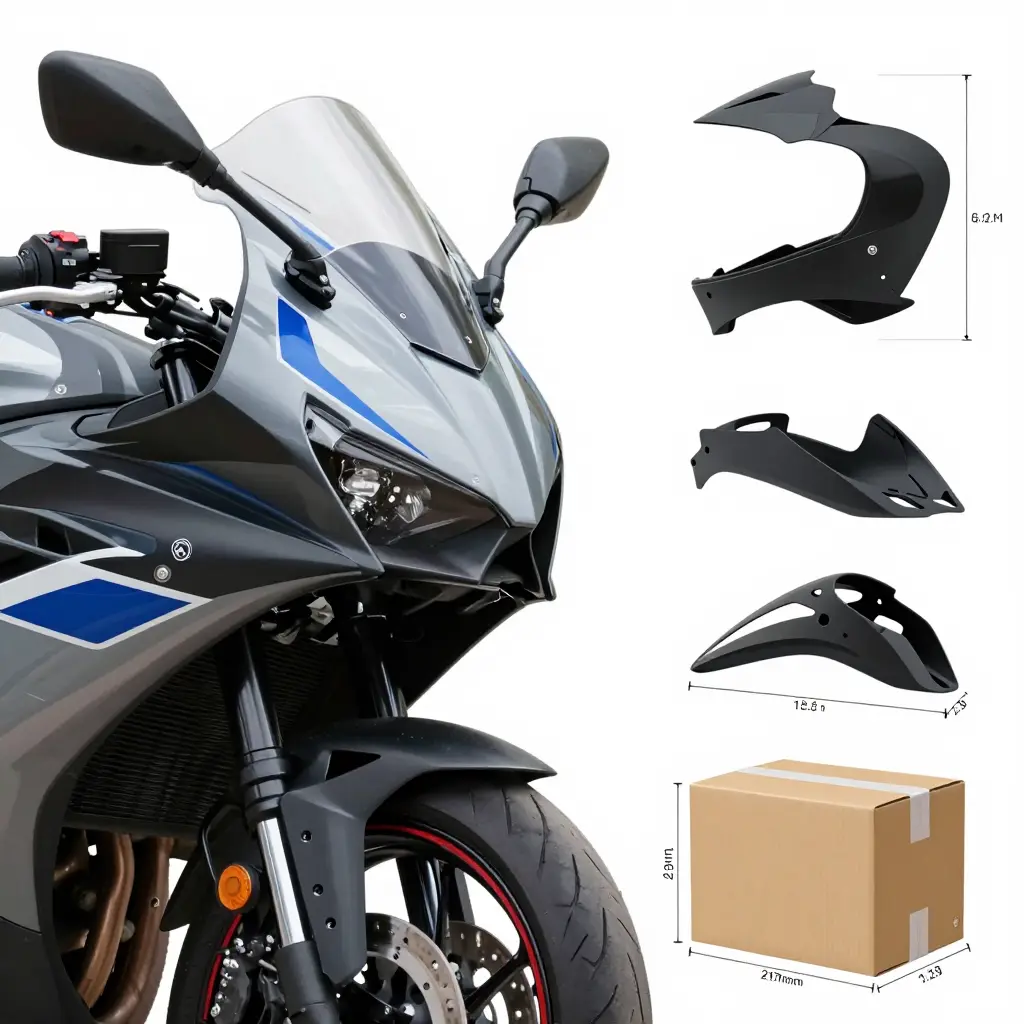
Dimensional weight (also called volumetric weight) turns volume into a billable figure, so a large, light package pays for the room it occupies. Motorcycle fairings sit squarely in that category: bulky cartons, low scale weight.
The DIM Divisor Formula
- Step 1: Measure the package – length x width x height.
- Step 2: Multiply them together to get the cubic volume.
- Step 3: Divide that volume by the carrier’s DIM divisor (commonly 5,000 for centimeters or 139 for inches).
- Step 4: The result is the dimensional weight.
- Step 5: Compare it to the actual weight and bill on the higher number.
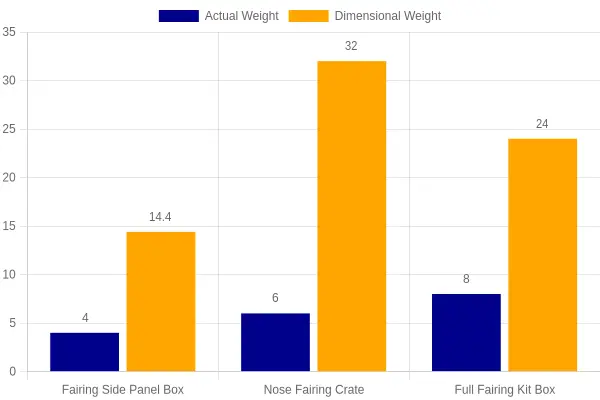
A fairing side panel box measuring 60 x 40 x 30 cm fills 72,000 cubic centimeters. Divided by 5,000, that comes to 14.4 kg of dimensional weight, even though the panel may weigh only 4 kg on the scale.
| Shipment | Dimensions (cm) | Actual Weight | Dimensional Weight (divisor 5,000) | Billable Weight |
|---|---|---|---|---|
| Fairing side panel box | 60 x 40 x 30 = 72,000 | 4 kg | 14.4 kg | 14.4 kg |
| Nose fairing crate | 80 x 50 x 40 = 160,000 | 6 kg | 32 kg | 32 kg |
| Full fairing kit box | 70 x 50 x 35 = 122,500 | 8 kg | 24.5 kg | 24.5 kg |
Carriers bill the higher figure because a truck or aircraft hold has fixed space. A light box that swallows a lot of volume pushes out other paying cargo, so it is charged for the capacity it consumes. That is why a featherweight motorcycle fairing panel can cost more to ship than a dense parcel of the same scale weight.
For importers the move is to shrink the box and pack it tightly. Trimming a few centimeters off a fairing carton lowers its dimensional weight, and since the higher number is what gets billed, that smaller footprint shows up as lower landed cost.
How Box Volume and Packaging Choices Drive Motorcycle Fairing Freight Costs
Fairings are light and bulky at the same time. A full set of panels can weigh under 10 kg yet need a carton big enough to hold three times that mass in empty air. Carriers rarely bill on scale weight alone, so that gap between low weight and high volume is where motorcycle fairing freight charges build up.
Oversize boxes and wasted void space
An oversize carton built around a few loosely stacked panels inflates box volume fast. Every centimeter of empty space counts toward the dimensions the carrier measures, and volumetric rules then override the scale reading. A carton measuring 120 x 60 x 50 cm bills at roughly 72 kg on volume, even though the fairing inside weighs only 8 kg.
Nested panels and compact packing
Nest and stack the panels tightly and the same set fits into a carton closer to 90 x 50 x 40 cm. The smaller volume drops the billed dimensional weight sharply, so importers pay for the space their parts actually occupy rather than the air around them. The table below compares the billed figures for the same fairing set under three packing approaches.
| Packaging Approach | Carton Size (cm) | Actual Weight | Billed Dimensional Weight |
|---|---|---|---|
| Oversize, loose panels | 120 x 60 x 50 | 8 kg | ~72 kg |
| Partially nested | 105 x 55 x 45 | 8 kg | ~52 kg |
| Tightly nested, compact | 90 x 50 x 40 | 8 kg | ~36 kg |
Volumetric divisors (usually length x width x height divided by 5000) exist for cargo like this, stackable or not. A tighter box shrinks the measured dimensions and cuts the billed weight even when the fairing itself feels light in the hand. Suppliers that ship motorcycle fairing kits nested rather than flat make the saving easier to capture.
Packaging is a line item, not a shipping detail. A smaller, denser box lowers freight, handling, and storage charges at every stage, and those savings land in the final landed cost of every fairing order.
How Shipping Method Affects Motorcycle Fairing Freight and Landed Cost
The shipping method can swing the delivered cost of a fairing kit by hundreds of dollars, because light, bulky boxes are billed on dimensional weight rather than actual weight.
| Shipping Method | Billing Basis (Actual vs Dimensional Weight) | Typical Transit Time | Relative Freight Cost | Impact on Landed Cost |
|---|---|---|---|---|
| Express Air | Billed on the greater of actual or dimensional weight (DIM divisor near 139); bulky fairing boxes bill almost entirely on DIM | 3-7 days | Highest ($$$$) | Pushes landed cost to the top; low-density fairing kits multiply chargeable weight several times over |
| Economy Air | Dimensional weight applies with a softer divisor; box volume usually outweighs the scale reading | 10-20 days | High ($$$) | Still DIM-sensitive; trims air premiums but leaves landed cost above sea options |
| Standard Sea Freight | Billed per cubic meter (CBM) or actual weight, whichever is greater; volume governs bulky kits | 25-45 days | Low ($$) | Delivers the lowest per-unit landed cost for large fairing kits and multi-piece sets |
| Consolidated Sea Freight | Shared container space billed per CBM; DIM becomes irrelevant once volume is priced | 30-55 days | Lowest ($) | Minimal landed cost; ideal for bulk fairing orders where timing is flexible |
| Road/Truck LTL | Actual weight plus freight class; dimensional weight applies when density falls below the carrier’s threshold, commonly around 6 lb per cubic foot | 2-10 days (domestic) | Medium ($$) | Moderate and distance-driven; short domestic hops keep fairings affordable door to door |
Dimensional weight and box volume, not raw weight, separate a cheap sea shipment from an expensive air one. Match the method to your deadline and order size, and the landed cost stays under control on every motorcycle fairing kit.
The Full Landed Cost Breakdown for Motorcycle Fairings
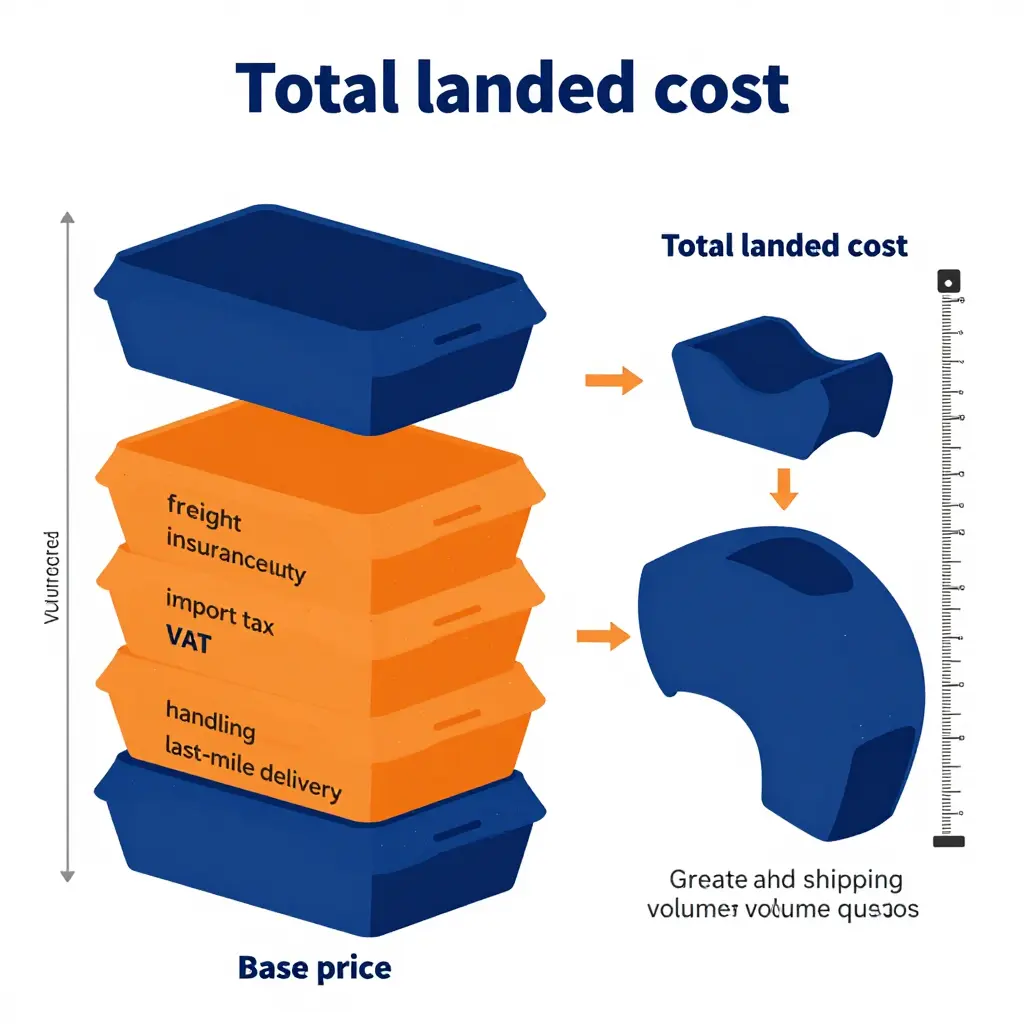
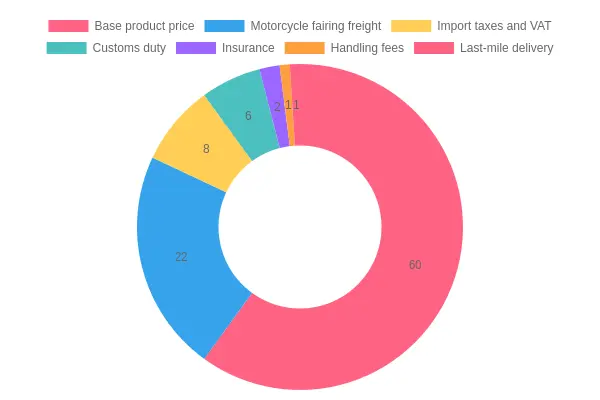
The price on a product page is rarely the price you pay. Landed cost is everything it takes to move a fairing kit from a supplier’s shelf to your door: the base item price plus freight, insurance, duty, taxes, handling, and last-mile delivery. The shares below are one illustrative split and shift with route, mode, and destination, which is why two identical fairing sets can end up costing very different amounts.
The Cost Components, One by One
1. Base product price. What the manufacturer or seller charges for the fairing set itself, before any transport or government charge touches it.
2. Motorcycle fairing freight. Shipping is calculated using the greater of actual weight or dimensional weight (also called volumetric weight). Carriers apply a formula such as length x width x height divided by a dimensional factor, so a bulky, light box is billed as if it were heavy.
3. Insurance. Covers the declared value of the shipment against loss or damage in transit. Normally a small percentage of the product value, but it rises with the declared amount.
4. Customs duty. A government charge based on the harmonized tariff classification and declared value of the goods. Rates vary by country and by product category.
5. Import taxes and VAT. Charged by the destination country, usually on the combined value of goods plus freight and duty, so they compound costs that are already stacked.
6. Handling fees. Charged by freight forwarders, brokers, or warehouses for processing, repacking, and customs paperwork.
7. Last-mile delivery. The final leg from a port or distribution hub to your address, often priced separately from the main freight charge.
| Cost component | What it covers | Typical share of landed cost |
|---|---|---|
| Base product price | The fairing kit itself | 60% |
| Motorcycle fairing freight (dimensional weight) | Air/sea/ground transport by billed weight | 22% |
| Import taxes and VAT | Government tax on goods plus freight plus duty | 8% |
| Customs duty | Tariff on declared value | 6% |
| Insurance | Coverage against loss or damage | 2% |
| Handling fees | Forwarder and brokerage processing | 1% |
| Last-mile delivery | Final leg to your address | 1% |
Why Dimensional Weight and Box Volume Swing the Total
Because freight is billed on the greater of actual or dimensional weight, box volume matters as much as the parts inside it. Two kits with identical panels can ship in very different packaging. A well-nested carton travels at a low billed weight; the same panels in an oversized box are re-rated upward, and that difference alone can add hundreds to the freight line. Import taxes and VAT are then calculated on the inflated goods-plus-freight total, so a bloated box lifts almost every line above it.
How This Connects to Paying Less at Summit Fairings
Packaging efficiency, consolidated freight, and accurate customs paperwork all affect these layers. Nesting fairings tightly keeps box volume, and therefore dimensional weight, low; streamlining freight and handling lets summitfairings.com offer customers 10-40% less than other sites on a comparable order. The affordable motorcycle fairings page shows how that translates into a lower delivered price.
A fairing that looks cheaper on the product page can cost more at the door once freight, duty, taxes, and handling are added. Comparing landed cost rather than sticker price is the honest way to judge which seller delivers the better value.
Where Your Money Actually Goes When You Ship a Fairing Kit
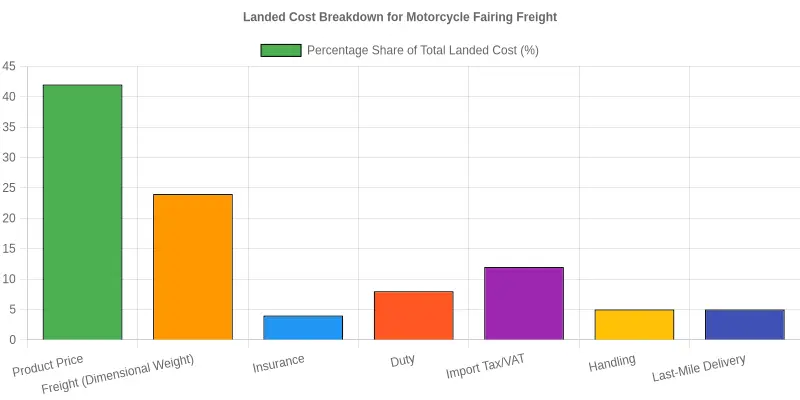
An overseas fairing kit rarely arrives at the price you expected. Freight is not a rounding error: for motorcycle fairings it is one of the largest lines on the bill, driven by dimensional weight and box volume. The split below is a second example, from a shipment mix where freight and tax take a larger share and the product price a smaller one.
The Landed Cost, Visualized
The chart below gives that second split, with freight sitting second only to the product price.
Reading the Bars
- Product price leads at roughly 42%: the panels themselves are the reason anything ships at all.
- Freight lands at about 24%. A fairing kit packed into a large, bulky carton is charged for the space it occupies, not for how heavy it is.
- Import tax/VAT (12%) and duty (8%) together add a fifth of the total, because both are usually calculated on the product value plus freight.
- Insurance, handling, and last-mile delivery are small on their own but add up to a meaningful slice.
The Full Breakdown at a Glance
| Cost Component | Typical Share of Landed Cost | What Drives It |
|---|---|---|
| Product price | 42% | Fairing material, finish, and brand |
| Freight (dimensional weight) | 24% | Box volume and dimensional weight divisor |
| Import tax / VAT | 12% | Destination country rules, taxable value |
| Duty | 8% | Tariff code and declared value |
| Handling | 5% | Warehouse labor and packing |
| Last-mile delivery | 5% | Local courier rates and address type |
| Insurance | 4% | Declared value and coverage tier |
Why Dimensional Weight Steals the Show
Dimensional weight reflects how much space a package takes up in a truck, a container, or a plane. The formula is simple:
Dimensional weight = (Length x Width x Height) / Dimensional factor
The factor varies by carrier and by air or ground service, but the effect is always the same. A fairing box is wide, tall, and shaped to protect curved panels, so its dimensional weight often exceeds its scale weight. That gap is how freight grows to rival the product price.
Packaging geometry is a cost lever, not just a protective measure. Tightening a carton by a few inches on each side can cut real money off every shipment. Fairings packaged with transit in mind show the difference across a whole catalog.
Turning the Breakdown Into Savings
Freight and taxes make up most of the back half of the bill. Four moves bring them down:
- Consolidate shipments. Combining several fairing sets into one carton spreads the fixed handling and last-mile costs across more product.
- Recheck box dimensions. Dimensional weight rules the freight line, so every cubic inch you reclaim is money back.
- Declare value accurately. Insurance, duty, and tax all scale with declared value, so precise paperwork avoids overpaying.
- Compare incoterms. Knowing who pays freight and duty at each stage keeps surprises off the final invoice.
The Bottom Line
Landed cost has many parts, but two of them matter most for fairings: freight and the dimensional weight that drives it. Knowing the breakdown lets enthusiasts, importers, and freight companies budget with real numbers instead of guesswork.
Practical Ways to Reduce Dimensional Weight and Motorcycle Fairing Freight Cost
Because carriers bill the greater of actual or dimensional weight, every packing decision changes your freight cost.
- Specify compact packaging up front – give your supplier the exact carton dimensions you want so oversized boxes never sneak in.
- Nest fairing panels together – interlocking curved panels into one another minimizes the box volume each shipment occupies.
- Trim void filler where it is safe – swap bulky foam for slim wraps and reclaim the empty air that adds cost without adding protection.
- Consolidate multiple fairing kits into one box – when you are buying motorcycle fairing kits, merging several orders into a single carton usually beats shipping several half-empty ones.
- Choose the right carrier divisor – confirm whether your courier divides by 139, 166, or 194 before you trust any quote.
- Request dim weight quotes upfront – always ask for dimensional weight pricing, not just scale weight, so surprises never land on your invoice.
- Compare dimensional weight across carriers – the same carton can be cheap with one courier and expensive with another.
- Split shipments only when it lowers total landed cost – breaking a load into two small parcels sometimes costs less than one bulky one.
- Use flat-packed, modular cartons – designs that stack flat reduce wasted space and let you fit more on a single pallet.
A few cubic inches shaved off each box lowers the dimensional weight the carrier charges, and the effect compounds across orders. Control box volume, nesting, and carrier choice, and freight spend drops along with landed cost.
How Dimensional Weight and Box Volume Affect Different Buyer Types
Fairing freight rarely follows the rule that heavier means pricier. Carriers bill on dimensional weight, the greater of actual weight or cubic volume divided by a dimensional factor, and that single calculation lands very differently depending on who is ordering and how much they ship.
Motorcycle Enthusiasts: One Fairing, One Box
A rider ordering a single fairing pays for air, not mass. The panel is light but needs a large carton, so dimensional weight takes over and drives the quote. Bolt-on kits that pack flatter, or a slightly longer ground transit, can cut the bill noticeably. Kits designed around box volume from the start ship cheaper.
Freight Companies: Optimizing Consolidated Loads
For consolidators, box volume is a puzzle of cubic space. Stacking several fairings onto one pallet raises actual weight but improves the volume-to-weight ratio, lowering dim weight per unit. The goal is to fill every cubic foot so a load bills on real weight rather than empty air, and a compact box volume is what makes fairing freight efficient.
Importers: Container-Level Strategy
Importers move thousands of units, so box volume decisions compound. A few centimeters trimmed from a carton design can add hundreds of units per container and lower landed cost per fairing. That is where supplier partnerships and operational scale deliver real importer value.
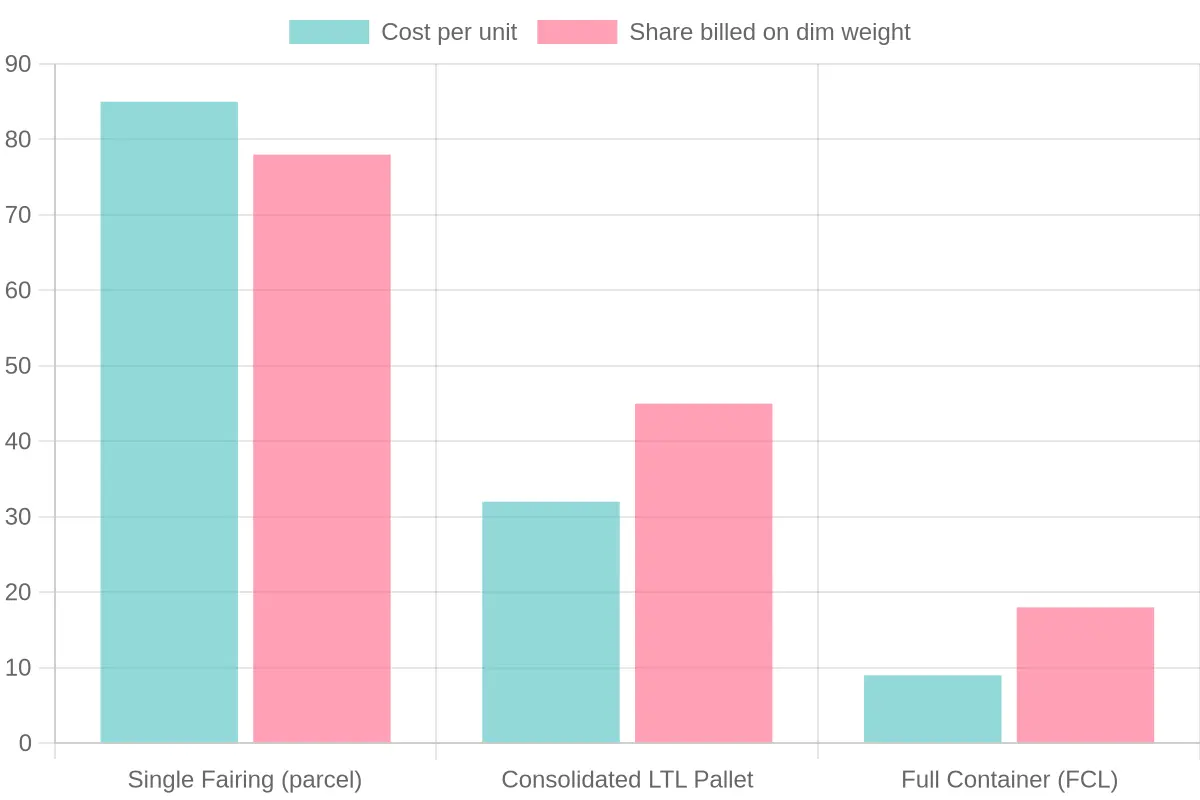
The chart below shows how per-fairing freight cost falls and how the share billed on dimensional weight shrinks as orders scale from a single parcel to a full container.
| Shipment Tier | Cost per Fairing (USD) | Share Billed on Dim Weight |
|---|---|---|
| Single Fairing (parcel) | 85 | 78% |
| Consolidated LTL Pallet | 32 | 45% |
| Full Container (FCL) | 9 | 18% |
Frequently Asked Questions About Motorcycle Fairing Freight and Landed Cost
What is dimensional weight and why does it matter for fairings?
Dimensional weight is how carriers charge for the space a package occupies rather than its scale weight. Fairings are large and light, so dimensional weight usually exceeds the physical weight and becomes the number that drives the freight bill. A bulky fairing carton can cost as much to ship as a much heavier, compact parcel.
How does box volume change my shipping charge?
Box volume, calculated as length times width times height, determines the dimensional weight the carrier will bill. Every extra inch of empty air inside the carton raises that volume, and many carriers divide the cubic size by a divisor such as 139 or 166 to produce the billable weight. A larger box therefore pushes your shipping charge up even when the fairing inside weighs exactly the same.
How is landed cost calculated for motorcycle fairings?
Landed cost is the total you pay to get fairings from the supplier to your door. It combines the product price with freight, insurance, customs duties, taxes, and handling fees. The freight portion is calculated using dimensional weight, so an oversized carton inflates the final figure. Adding every fee together gives you the true landed cost rather than just the sticker price.
Can I lower freight by choosing a smaller box?
Yes. A smaller box reduces box volume, which reduces the dimensional weight the carrier bills. Packing fairings tightly and removing empty space can drop a shipment into a lower billing tier. Just make sure the smaller carton still protects the parts in transit.
Why are fairings billed by volume when they are light?
Carriers charge for the capacity a package consumes, not just the mass it adds. A light but bulky carton of fairings takes up cargo space that could have held heavier goods, so the carrier prices it using dimensional weight. That keeps charges consistent with the space actually used.
How does summitfairings.com help reduce total landed cost?
summitfairings.com consolidates fairings into compact packaging that keeps box volume and dimensional weight low. Lower dimensional weight means lower freight, which flows into a smaller final landed cost. The result is a clearer, more affordable price from checkout to delivery, one of the motorcycle fairings business advantages importers look for.
Conclusion and Buying Guidance
The math behind fairing freight is simpler than it looks. Dimensional weight, not the scale reading alone, and box volume drive what carriers charge and shape the final landed cost. Plan for both early.
Key Takeaways
- Billing rule: carriers bill the greater of actual or dimensional weight, so light, bulky fairing boxes cost more than their scale weight suggests.
- Reduction moves: nest components, trim empty space, pick right-sized cartons, and consolidate shipments.
- Who it affects: single-kit enthusiasts, freight companies moving pallets, and importers scaling volume all face the same pressure.
Every choice, from foam thickness to pallet stacking, feeds back into the landed cost you pay at the door, and small packaging gains compound across hundreds of shipments.
Why Planning Pays Off
Box volume is something you control, unlike headline rates. Compact packaging lowers dimensional weight, avoids surcharges, and protects fragile fairings better in transit.
At summitfairings.com, you get more than parts. The store carries over 3,000 fairing styles, prices 10-40% lower than other sites, and answers your questions within six hours.
For deeper context, review motorcycle fairing kit benefits and the business advantages behind fairing sourcing.