
Motorcycle Fairing Insulation: Where Inner Panel Temperature Really Comes From
Two things set the temperature of the plastic inside a fairing: how much radiant heat the inner face throws back, and how well the air gap behind it keeps that heat away. Engine output matters, but it reaches the panel through those two routes.
Panels rarely melt because the engine is simply too hot. They fail when heat enters the material faster than the material can shed it, so the panel keeps climbing until the ABS or composite reaches its softening range.
What matters, then, is how the reflective layer behaves, what the air gap does at different widths, and what to put in writing when you order custom fairings from Summit Fairings or anyone else, so the panel lasts through long, hot rides.
What Is Inner Panel Temperature?
Inner panel temperature is the surface temperature on the inside face of a fairing panel, the side that faces the engine, exhaust and radiator, not the painted skin you see from outside. The gap between the two readings can reach tens of degrees, and the inner face is the one that decides how long the part lasts, how paint and decals hold up, how fast wiring and connector housings age, and how much radiant heat reaches a rider’s legs in slow traffic.
That hidden surface is also the number worth tracking, because it is where motorcycle fairing insulation does its work: a reflective barrier plus a trapped air gap pulls it down measurably, while bare plastic soaks heat up and passes it along. Measure at steady state, with the engine fully warm, using a contact or infrared thermometer at the same marked points each time.
The buying version is simpler. Ask what the inner face reads on a hot bike, and check that the bodywork leaves room for both a barrier and an air gap; you can compare that across custom fairings for your model.
How Heat Reflection Works Inside the Fairing
Radiant heat from the engine, the exhaust headers and the radiator crosses the air gap until it hits the inner face. A low-emissivity reflective barrier there sends most of it back toward the source and absorbs little, so only the remainder warms the plastic.
Surface finish matters more than color. A polished, metallized or foil face reflects strongly because its low emissivity limits how much energy it can re-emit into the panel, while a matte or painted inner face absorbs and re-radiates into the material whatever the outside of the fairing looks like.
Dirt kills the effect. Dust, oil mist and grime raise emissivity and turn a reflector into an absorber, so look at the inner face whenever you fit new custom fairings.
Reflection decides how much heat reaches the material at all; every other layer only deals with what gets past.
Why Heat Reflection Comes First in the Insulation Stack
Radiant heat needs no flame, no contact and no airflow. Once the engine cases and exhaust headers are at operating temperature they radiate infrared across the space behind the side panels, and whatever surface it lands on absorbs it and warms up, unless something is in the way.
That is the reflective layer’s whole job. It does not cool the engine and it does not block hot air; it refuses to accept the heat on the panel’s behalf. The rest of the stack supports that first decision and handles what slips past it.
Three layers sit between the engine and the paint, in this order: an outer painted panel, an air gap, and a reflective barrier facing the engine.
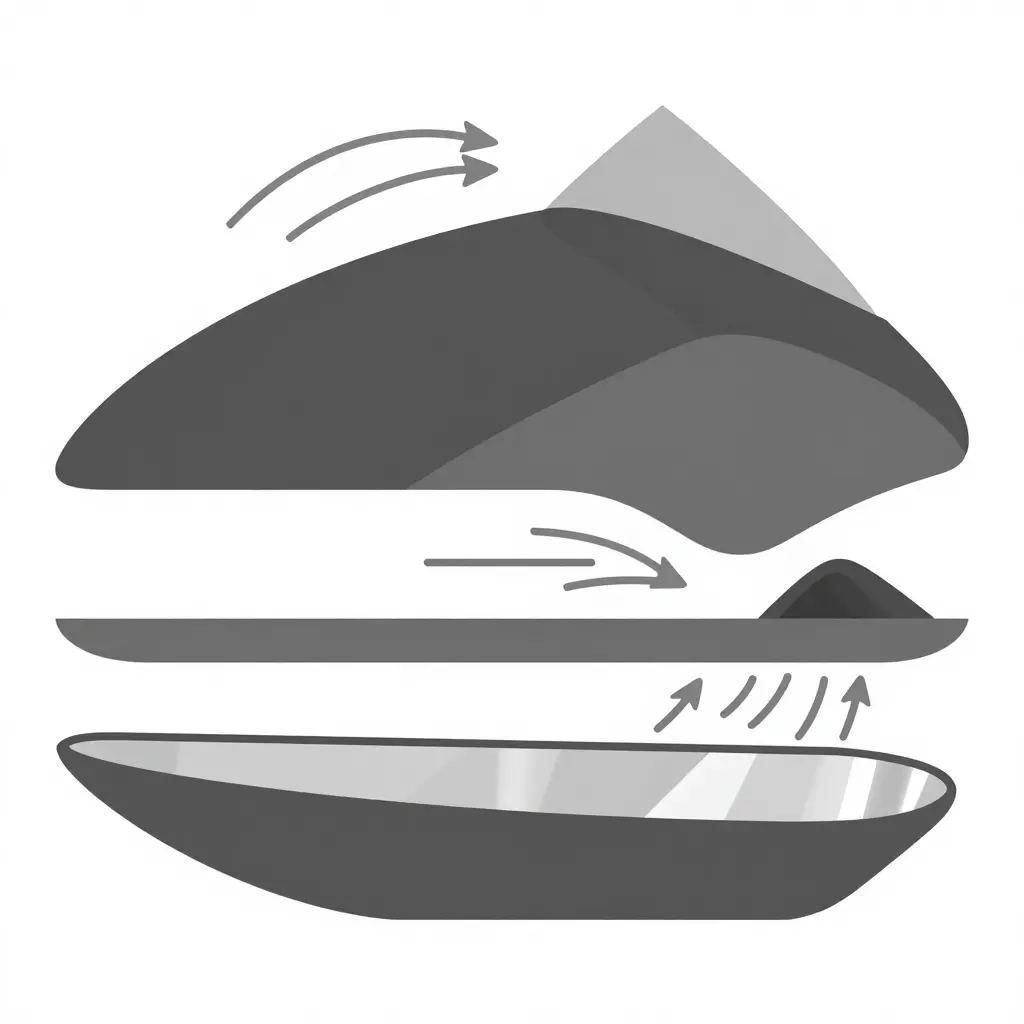
Figure 1: A flat cross-section of motorcycle fairing insulation, showing reflected radiant heat bouncing away and warmed air leaving through the vent path.
Layer 1: The outer painted panel
Paint, clear coat and decals all last longer inside a narrow temperature band, and repeated heat cycling is what dulls a finish and starts edges lifting. The outer panel is also the last line of defense, so it works only as well as the layers behind it. When you are choosing custom fairing sets, ask whether the inner surface has been prepared to carry a barrier, because bare ABS has nothing to reflect radiant heat with.
Layer 2: The air gap
Air conducts heat poorly, which is why a still pocket of it insulates so well. Thickness matters in both directions. Squeeze the gap until the barrier touches the panel and you have built a bridge that conducts heat straight through. Open it too wide and the air starts moving on its own, rising in convection loops that carry warmth upward instead of holding it, and you run into fitment trouble around the tank and controls.
Layer 3: The inner reflective barrier
The barrier faces the heat source, not the road. Its low-emissivity surface bounces most incoming radiant energy back toward the engine and exhaust before it can be absorbed, and the thin substrate underneath slows what little gets through.
What the arrows are telling you
- Bouncing arrows: reflected radiant heat returning to its source rather than soaking into the fairing.
- Arrows inside the gap: convection. Air that has picked up residual heat expands, rises, and needs a way out.
- The vent direction: why sealing every gap is a mistake. Trapped hot air has to go somewhere.
For a shop or a fleet, this is diagnostic material. A rider who says a side panel is too hot to touch after twenty minutes is usually describing a reflection problem, an air gap problem, or both. Knowing the stack lets you explain it in plain language and sell the right fix instead of guessing at thicker padding.
Gap width and vent placement change the numbers, and more insulation is not automatically better.
Why the Air Gap Acts as the Primary Thermal Resistance
A narrow, closed pocket of air between a hot component and a painted panel does most of the insulating work in the assembly, and it matters far more than the finish on the outside of the fairing. Heat has to crawl across that pocket by conduction, at a modest rate.
Widen the gap too far and the air stops sitting still. Convective heat transfer takes over, rising loops of warm air carry energy from the source to the panel, and inner panel temperature climbs even though the assembly technically contains more insulation. Press the panel against the hot side and the resistance disappears altogether, because solid contact conducts heat straight through the plastic.
The trade-off cannot be designed away. Thicker gaps insulate better up to a point, but thin panels flex, custom fairings differ in wall stiffness, and assembly tolerance drifts, so a gap that varies across the part gives unpredictable results. Consistency beats raw thickness, which is why buyers should put a target gap range in the spec sheet instead of leaving the distance to assembly guesswork.
Quick Comparison Table: Reflective Layer vs. Air Gap
Reflection and air gap rarely work alone. Foil bonded flat to a panel still conducts heat into it, and a deep gap with no reflective surface just gives hot air room to swirl. Buyers comparing quotes usually want both variables in one view, so the table below is built to drop into a spec review or a supplier call. If you are already shortlisting replacement bodywork, the wider range of custom fairings shows how these configurations turn up on real bikes.
| Insulation configuration | Reflective layer | Air gap thickness | Typical effect on inner panel temperature |
|---|---|---|---|
| Bare painted panel | None | None | Baseline reference, panel runs hottest |
| Foil-backed reflective sheet only | Yes, single foil face | None, sheet bonded tight to panel | Some benefit, but absorbed heat still passes straight into the panel |
| Reflective sheet with 5 mm closed gap | Yes | 5 mm, still air, sealed edges | Moderate reduction, thin gap saturates early |
| Reflective sheet with 15 mm closed gap | Yes | 15 mm, still air, sealed edges | Substantially lower, strong balance of clearance and performance |
| Reflective sheet with wide open gap plus venting | Yes | Wide, open and ventilated with moving air | Lowest inner panel temperatures, but bulky and highly layout sensitive |
Values depend on engine layout and measurement point, so read these descriptors as relative guidance rather than fixed figures.
How to read the table
- Start with column four: it is what the rider and the wiring behind the panel actually experience.
- Treat the reflective layer as a ceiling on radiant heat and the air gap as the resistance that stops the rest from conducting.
- Go down the rows only as far as your packaging allows. A wide ventilated gap that cannot be sealed properly often performs worse than a clean 15 mm closed gap.
Use the table to filter suppliers during quoting, then confirm the final specification against your own panel geometry and heat sources before you commit to tooling.
No single figure describes inner panel temperature; it depends on where you measure and how the bike is ridden. These are the variables we check on every set of custom fairings:
- Distance between panel and heat source – a wider gap spreads heat across more air, so the skin runs cooler.
- Anything that bridges the gap – each mounting standoff is a contact point that leaks heat into the panel.
- Venting and ambient airflow – open vents flush hot air out and moving air strips heat away, while a sealed panel in stationary traffic just traps it.
- Emissivity of the inner surface – low-emissivity reflective coatings bounce radiant heat back toward the engine, and full coverage of the hot zone beats a small patch.
- Panel thickness and material – thicker, denser laminates resist conduction but add weight.
- Load pattern and exhaust routing – sustained high-rpm running soaks the panel steadily, stop-and-go riding lets it cool between bursts, and pipes routed close to the inner skin create stubborn local hot spots.
Work through them and you will know where a hot panel is coming from.
Five Configurations, One Straight Comparison
When a rider asks why one fairing runs cool and another bakes its own wiring, these are the five setups worth comparing. Each pairs a heat-management idea with what it does to the panel skin:
- Bare panel, no barrier – the inner skin alone, soaking up radiant engine and exhaust heat with no layer in between and nowhere for it to escape.
- Reflective foil only – a metallized sheet bonded straight onto the panel, bouncing heat back toward the source before it can be absorbed.
- Air gap only, 10 mm – a trapped pocket of still air acting as a thermal break, with no reflective surface involved.
- Foil plus sealed air gap – reflection and a closed air cell together, which is where most of the gain shows up.
- Foil plus vented air gap and standoffs – reflection, a controlled gap, and enough airflow to carry heat away instead of parking it against the plastic.
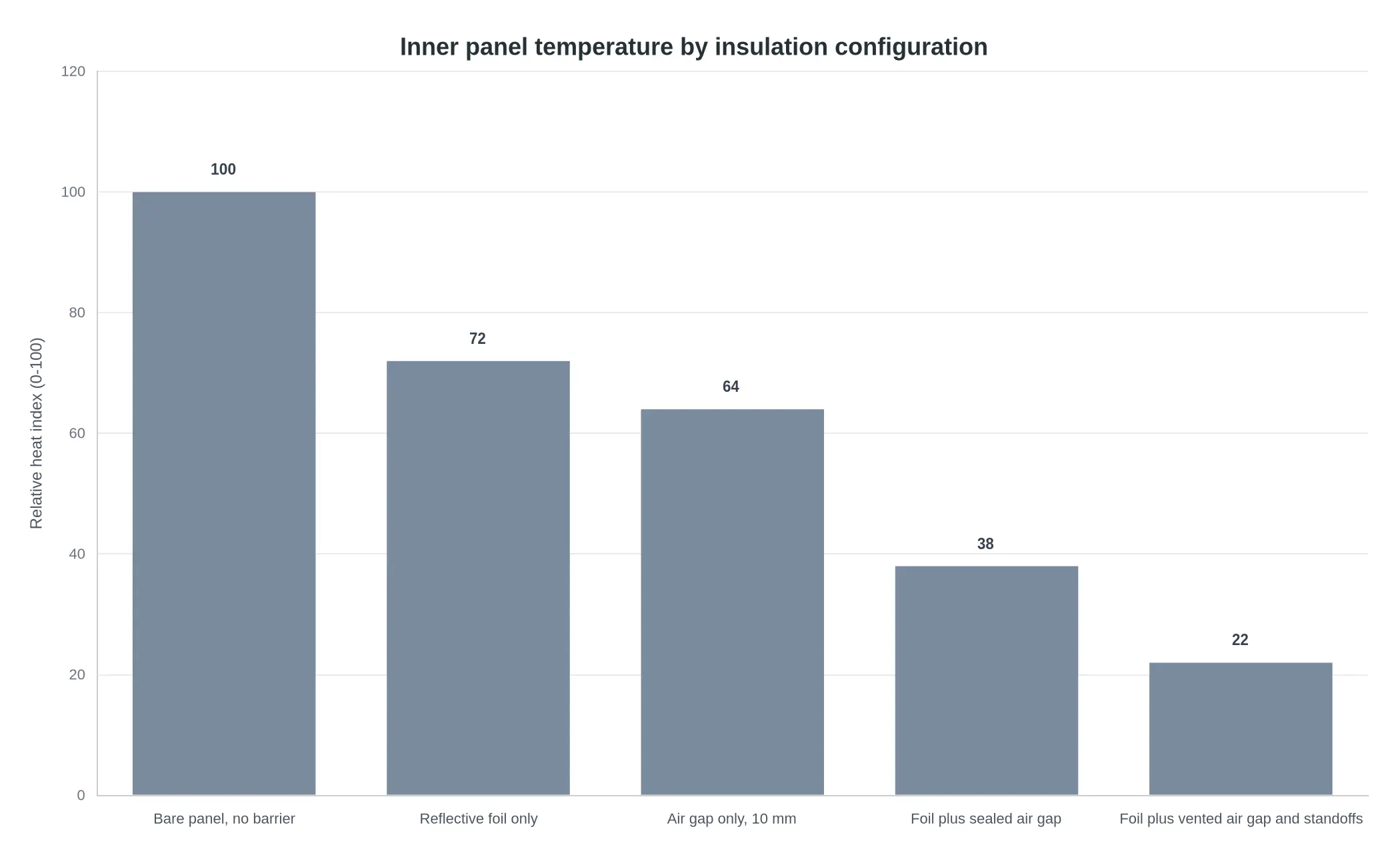
Note: the values are relative indices for illustration only, not measured temperatures in degrees.
The ranking is straightforward. Reflection does most of the work as soon as a metallized layer goes in, a sealed air gap adds to it by cutting conduction through the panel, and a vented gap with standoffs gives the coolest inner panel of the five. That is the logic behind our custom fairing sets, where the mounting hardware holds the gap open rather than pressing the panel flat against the frame.
Reflective Surfaces and Material Choices
Every layer on the back of a panel does a different job. Low-emissivity foil and metallized film refuse to radiate stored heat inward; ceramic-filled coatings spread hot spots and survive vibration better than bare foil; fibre-reinforced backing adds stiffness as much as thermal mass. Emissivity, not thickness, decides how much radiant energy a surface gives back, so a dull inner face absorbs and re-radiates heat even through a good reflective barrier.
When the gap between fairing and engine is small, a reflective inner face outperforms a thick insulating blanket: there is not enough air for the blanket to do useful work, so the reflector handles radiation directly. With a generous gap, or panels sitting close to the headers, a blanket earns its place by slowing conduction and convection. Inner-face color is mostly beside the point for engine radiant heat, because white and black paint both emit and absorb in the infrared about equally well; a foil face is what actually reflects.
Practical note: aftermarket fairing sets vary widely in whether these layers are included at all, so confirm the specification, and the level of motorcycle fairing insulation, before assuming a panel is reflective.
How Air Gap Thickness Changes Inner Panel Temperature
Once the reflective layer is doing its job, the next variable you control is the gap. The chart below plots a relative inner panel temperature index against gap thickness, from a flush panel at 0 mm out to 30 mm, for two riding conditions.
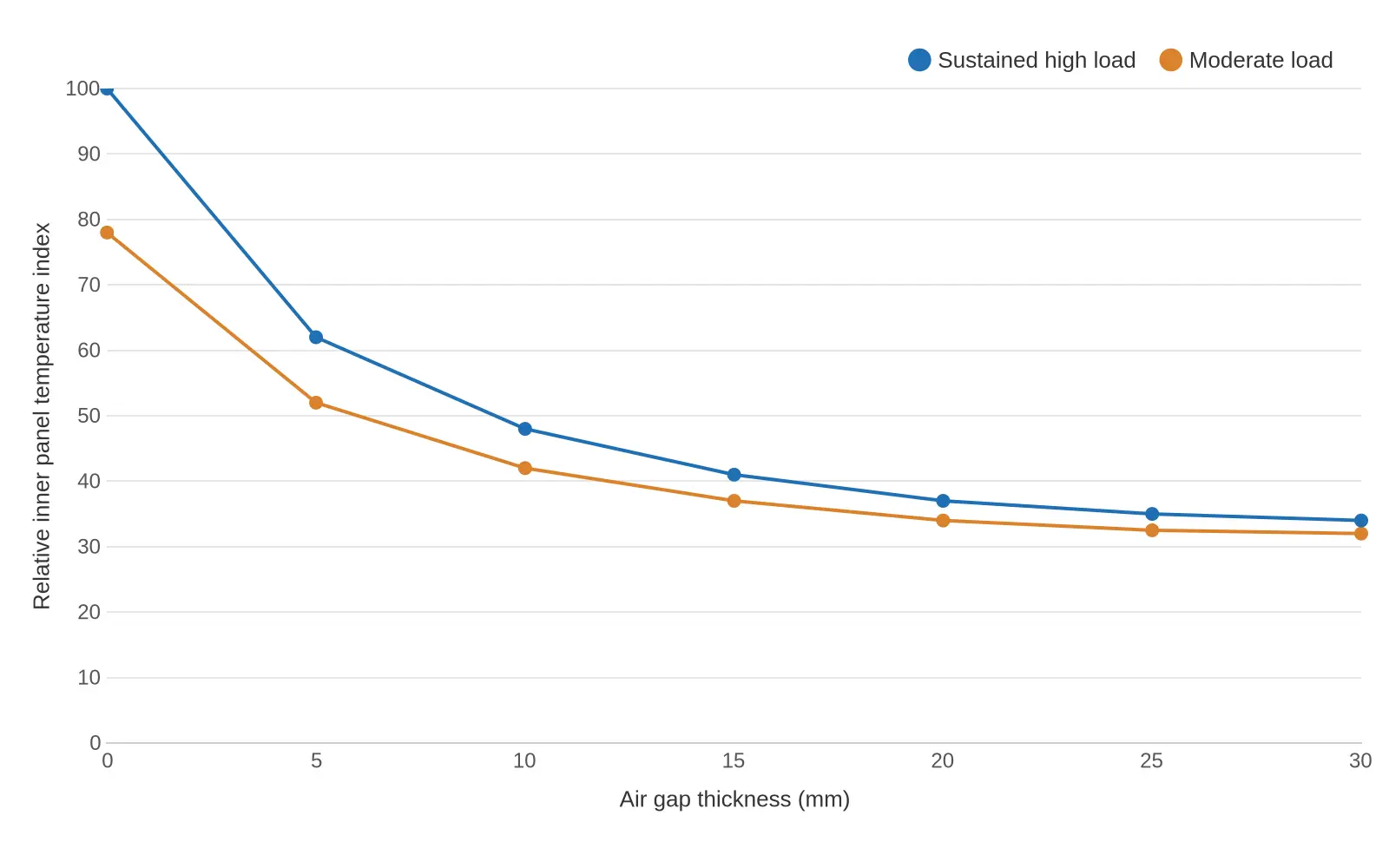
Note: the curves are schematic and intended to show the shape of the relationship, not measured values from a specific bike.
The diminishing returns are the point. The first 10 mm of gap buys the largest drop in inner panel temperature, and past roughly 15 to 20 mm the curve flattens because convection has taken over and moving air, not gap width, is doing the cooling. A modest, well-ventilated gap paired with a reflective inner surface therefore beats a cavernous cavity that traps hot air, which is how the panels in our custom fairings collection are laid out.
Write Heat Performance Into the Specification, Not the Conversation
Most aftermarket suppliers build to the cheapest interpretation of a vague order. Every unstated requirement – reflective layer, air gap, venting – silently defaults to the lowest-cost build, and you find out when inner panels blister in summer traffic. Treat motorcycle fairing insulation as a defined line item rather than an assumption, and quote against a supplier with a documented range such as the custom fairings collection, or a model-specific set like these Kawasaki fairing kits, so every vendor bids to the same baseline. Put three requirements in writing:
- Reflective layer: the inner face must carry an aluminium reflective layer, with declared emissivity of 0.05 or lower stated on the datasheet.
- Air gap and venting: standoff height of 10 to 15 mm held by fixed spacers, plus vent gaps at both panel edges to let hot air escape.
- Temperature proof: a stated inner panel test method, with thermocouples at the exhaust-side lower cowl, mid-panel and upper vent, measured at idle and under road load.
Frequently asked questions
Is a reflective layer alone enough without an air gap?
Not on its own. A reflective layer bonded flat to the panel still bounces radiation, but with no air space behind it, the heat it does absorb has a direct path into the plastic and most of the available gain is lost. The reflective surface needs a still air space so radiated heat is turned back before it reaches the panel. Fit the barrier on a standoff of at least 10 mm.
Is a wider air gap always better?
No. Gains improve as the gap grows up to roughly 20 mm, then flatten, and airflow across the gap starts to matter more than width. A gap that is too wide adds weight, invites turbulence, and lets the fairing flex under load. Keep it between 10 mm and 20 mm for the best return.
Does inner panel temperature matter for street bikes as well as track bikes?
Yes. It matters on any machine that holds a steady throttle. Street riding produces long, hot, low-speed sessions where airflow is weakest, so the panel accumulates heat in traffic; track bikes see sharper spikes but shorter exposure. Both benefit from the same reflective barrier and a controlled air gap.
How do I check whether an existing fairing set already has a heat reflective barrier?
Pull the side panels and look at the inner surface for metallic foil, a woven mat or a coated film bonded to the plastic. Tap it with a knuckle: a hollow sound suggests an air gap behind, though it will not tell you how thick the gap is. Our team answers questions about specific sets within six hours, and you can browse the current uncategorized fairing inventory to compare configurations.
Conclusion: Two Factors Decide What the Inside of a Fairing Endures
Two variables decide how hot the inside of a fairing gets. Heat reflection controls how much radiant energy the inner face absorbs, and the air gap controls how much of the rest reaches the panel material. For a buyer, checking those two design details tells you more than comparing price or finish. A panel that reflects heat and holds a consistent gap will outlast one that does neither, ride after hot ride.
Summitfairings carries more than 3,000 styles covering nearly every motorcycle model, including custom Ducati fairings and custom Honda fairings, generally priced 10-40% below other sites, with a six-hour response commitment on all enquiries.