

Honda VFR 750 Fairing Price: The Two Variables That Decide the Number
Two things move the price of a Honda VFR 750 fairing: how many panels the kit contains, and how much of the surface has to be painted. Panel count is the number of individual moulded pieces you receive, from a bare upper cowl up to a full set of side panels, tail sections and fenders. Paint coverage is the area that gets prepped, primed, colour-matched and cleared, and it grows with panel size and again with every extra colour in the scheme.
The two rarely move apart. A kit with more panels almost always adds painted surface, so two quotes built on the words “full set” can land far apart without either supplier being wrong. Buyers ordering in volume can use the breakdown below to put those quotes on the same footing.
Why the Same Motorcycle Produces Very Different Fairing Quotes
Every supplier is quoting for the same motorcycle, yet the totals still separate. Mostly that comes down to terminology, because “full set” has no agreed definition between suppliers. Three gaps account for most of the spread.
- Kit composition: some suppliers count painted outer shells only. Others put inner dash panels, brackets and trim inside the same set and quote a higher total for an identical bike.
- Paint specification: quotes often omit whether paint is included at all, or how many colours it covers. Multi-colour work tends to arrive bundled into one figure instead of being priced panel by panel.
- Material and packing: heavier-gauge plastic and reinforced crating cost more to move, and that cost lands in the total without appearing anywhere on the panel list.
Ask for three things before comparing totals: the panel list, a paint spec naming the colour count, and the shipping basis. Lining up Honda fairings collections side by side shows how panel counts shift between model years.
What a VFR 750 Fairing Kit Actually Contains
Panel lists are where quotes stop being comparable. A typical VFR 750 kit breaks down like this, and our Honda fairing collections are listed the same way:
- Upper nose cowl: the lead panel, present in nearly every kit.
- Left and right main side fairings: sold as a matched pair.
- Front fender: included by some suppliers, a separate line item for others.
- Fuel tank cover: usually included; a replacement tank is not.
- Lower V-piece or belly pan: common, occasionally optional.
- Tail section and seat cowl: usually included, though a solo seat cowl can be quoted on its own.
- Inner dash and duct panels: frequently sold separately, so ask.
- Mounting brackets and trim hardware: often separate, and rarely part of a painted set.
Eight items. Count them against any supplier quote before you compare Honda VFR 750 fairing price figures.
Panel Count and Typical Price Band
Panel count comes first because every extra moulding costs material, prep time, and another surface to prime, base and clear.
| Kit configuration | Panel count | Components included | Relative material cost | Relative paint cost | Price band index |
|---|---|---|---|---|---|
| Fairing-only set | 5 panels | Upper, lower, side panels, tail | 55% | 40% | 100 |
| Standard road set | 7 panels | Above plus front fender, tank cover | 70% | 62% | 118 |
| Full set with inner panels | 11 panels | Above plus inners, air ducts, trim | 88% | 85% | 142 |
| Full set plus spare panels | 14 panels | Above plus spare side and nose mouldings | 100% | 100% | 168 |
The index column climbs faster than the panel count, but not in proportion. The 14-panel set carries roughly three times the mouldings of the five-panel set and lands at 168 rather than 300, because material and paint costs do not scale in a straight line. The steps also buy different things. Going from 142 to 168 pays for spare mouldings, which change nothing about the finish; paint on the same panels takes the index to 195, and that is the part a customer sees.
Quotes from different model families only compare once the configurations match. A five-panel set and a 14-panel set are not the same product, and catalogue listings per model year make the difference visible before you order.
Two things to settle while planning. Inner panels and air ducts are the pieces budget quotes most often leave out and add later, so confirm them in writing. Spare panels belong in the index only if you expect damage; they raise the total and do nothing for the finish.
Panel Count: Where the Money Actually Goes
Each additional panel restarts the same fixed sequence: its own mould cycle, its own finishing pass, its own set of handling steps. That is why a kit with four extra panels costs more than the extra material alone would suggest.
Every added piece also consumes more ABS or fibreglass sheet, and each one carries a separate fitment and gel-coat inspection. Carton volume grows with the kit too, which pushes freight per kit upward even where the weight barely moves.
| Cost layer | How it behaves as panel count rises |
|---|---|
| Mould cycle and finishing pass | One full cycle per panel, no batch discount |
| Sheet area (ABS or fibreglass) | Scales with surface area, piece by piece |
| QC checkpoint (fitment, gel coat) | One inspection per panel |
| Carton volume and freight per kit | Jumps at box-size thresholds |
Packing and QC move in steps rather than smoothly, so a kit with four more panels is billed as four more steps rather than a quarter more. Each step stacks labour, inspection time and carton space on top of the last instead of blending into the batch already running. Budget for the jumps, not the arithmetic.
What the Price Index Says About Kit Configuration
The fairing-only set is the base of 100, and the first four bars hold the paint specification constant so that kit composition alone moves the number. The fifth applies a multi-colour scheme to the same full set.
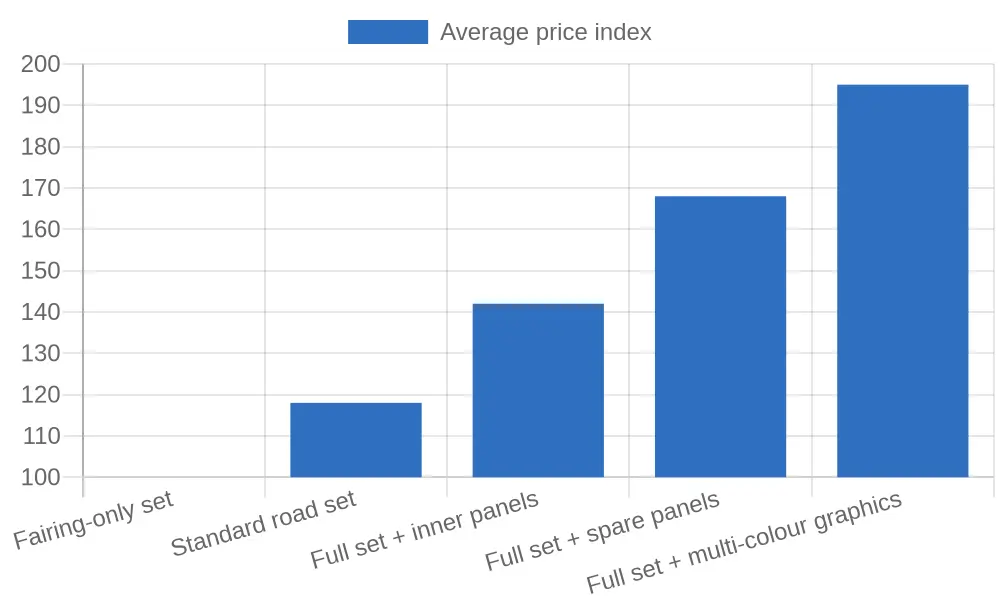
Reading the Bars
- Fairing-only set (100): the reference point, main outer panels in a single colour.
- Standard road set (118): adds the panels most road bikes carry, an 18-point lift for a modest gain in coverage.
- Full set with inner panels (142): adds moulded parts and extra surface that has to be masked, 24 points for four more panels.
- Full set with spare panels (168): redundancy you pay for now rather than on a second order later in the season.
- Full set with multi-colour graphics (195): the top of the range, where graphics layout and colour separation drive the premium instead of panel count.
Turning the Chart Into a Decision
Fairing-only to full set with inner panels is roughly 42 index points. Graphics on top of that full set add about 53 more. For a business stocking or repairing a VFR 750, the question is whether the extra panels and paint coverage earn back their cost in resale or in bikes that sell faster. Where they do, buy the configuration once instead of layering upgrades onto stock later.
You can browse the full range of Honda fairings to match a configuration to your build.
Paint Coverage: The Second Cost Variable
Paint coverage describes how much of the fairing surface receives paint and how many distinct colours and graphic layers sit on it. More coverage means more masking, longer booth time and repeated re-masking between colours, so labour rises with every added colour. Because colour boundaries must line up across adjoining panels, higher coverage also raises the rejection rate at final inspection.
Single solid colour. One spray cycle, minimal masking. Labour is lowest and rejection risk stays small.
Two-tone with a dividing line. The second colour adds a masking stage and a second booth pass, and the dividing line has to mirror exactly across the left and right panels. Misalignment there is the most common source of rework.
Multi-colour scheme with painted graphics. Each colour repeats the mask, spray, cure and re-mask cycle, which multiplies booth hours. Every new boundary that crosses a panel seam is another point where line-up can fail.
Painted base with applied decals. Decals cut booth time but add placement labour, and the clear coat over them still needs full-surface finishing. Panel seams again decide whether the graphics align.
A quote from a Honda fairing collection therefore reflects the paint scheme far more than the plastic. Multi-colour work at the top end pushes the VFR 750 fairing price well above a single-colour set built from the same panels, and the difference is labour hours plus the rejection risk attached to them.
Where the Money Actually Goes on a VFR 750 Fairing
Business buyers usually ask why one VFR 750 fairing set costs more than another when both fit the same bike. The plastic is rarely the answer. Panel count and paint coverage carry the price; packing and freight make up the rest.

The diagram separates the two cost lines. Each shape is one panel, and the colour zones on it map to workshop hours.
Reading the colour zones
- Single-colour panels are cheapest to produce: one mix, one pass, one cure. There is no masking sequence to get wrong and very little waste.
- Two-tone panels introduce a split line. Someone masks, sprays, lets it flash off, then unmasks and sprays the second colour, and that split has to land in the same place on every unit.
- Multi-colour panels are where coverage compounds. Adhesion promoters, stripes, decal boundaries and clear coat stack on each other, and each layer resets the clock.
The stacked layer motif on the right of the diagram is what buyers underestimate: base coat, colour coats, then clear coat. All three run across the whole set, not only the decorated panels, which is why a plain white set and a three-colour replica livery with identical panel counts still land at different prices.
Panel count and coverage, side by side
| Cost variable | What it changes | Effect on the quote |
|---|---|---|
| Panel count | Number of moulded parts, brackets and fixings | More parts means more prep, test-fitting and packing labour |
| Paint coverage | Single colour, two-tone split or multi-colour livery | Each added colour adds masking, flash-off and re-masking time |
When you order in volume, keep the two questions apart: how many moulds, then how many colour zones sit on each mould. A single “painted set” request bundles them, and that is where quotes drift. Across model years, the Honda fairing collections make the panel differences visible before you commit to a livery.
Reading a Quote: Separating Panels from Paint
Supplier quotes arrive in whatever format suits the supplier. Rebuild each one into two line groups before you look at the total.
Line group 1 – panel count. List every piece included: upper cowl, side panels, lower fairing, tail, front fender, tank cover, inner ducts. Count them and note what is absent. A quote with 14 pieces and one with 19, brackets and trim included, describe different products.
Line group 2 – paint coverage. Record whether the price covers a single colour, a multi-colour scheme, clear coat, or primed ABS only.
Then work through three checks in order: the panel list, the coverage level, and whether decals are painted into the clear coat or applied as stickers. Suppliers quoting 10-40% above the summitfairings.com baseline usually differ on one of those two lines rather than on the panels. Compare our Honda fairing collections against any quote using this structure.
Ordering in Volume: Matching Kit Spec to Demand
Buy against the repair mix you actually sell, not against a theoretical full range. Count the damage you repaired over the last 90 days: if nose and side panels dominate, weight the order toward those panels instead of balanced sets.
- Standardise on two or three paint coverage levels, for example single-colour, two-tone and full graphic, rather than spreading capital across every finish variant.
- Keep spare single panels for your most frequently damaged parts, so a stalled job never becomes a discount request.
- Confirm carton dimensions before you commit to volume, so freight per unit is a known figure in your margin calculation.
- Consolidate mixed-model orders into one shipment. A catalogue of over 3,000 styles across almost all motorcycle models makes this realistic, so review the broader fairing catalogue before splitting purchase orders. The same discipline works for comparable Honda coverage, including the CBR range.
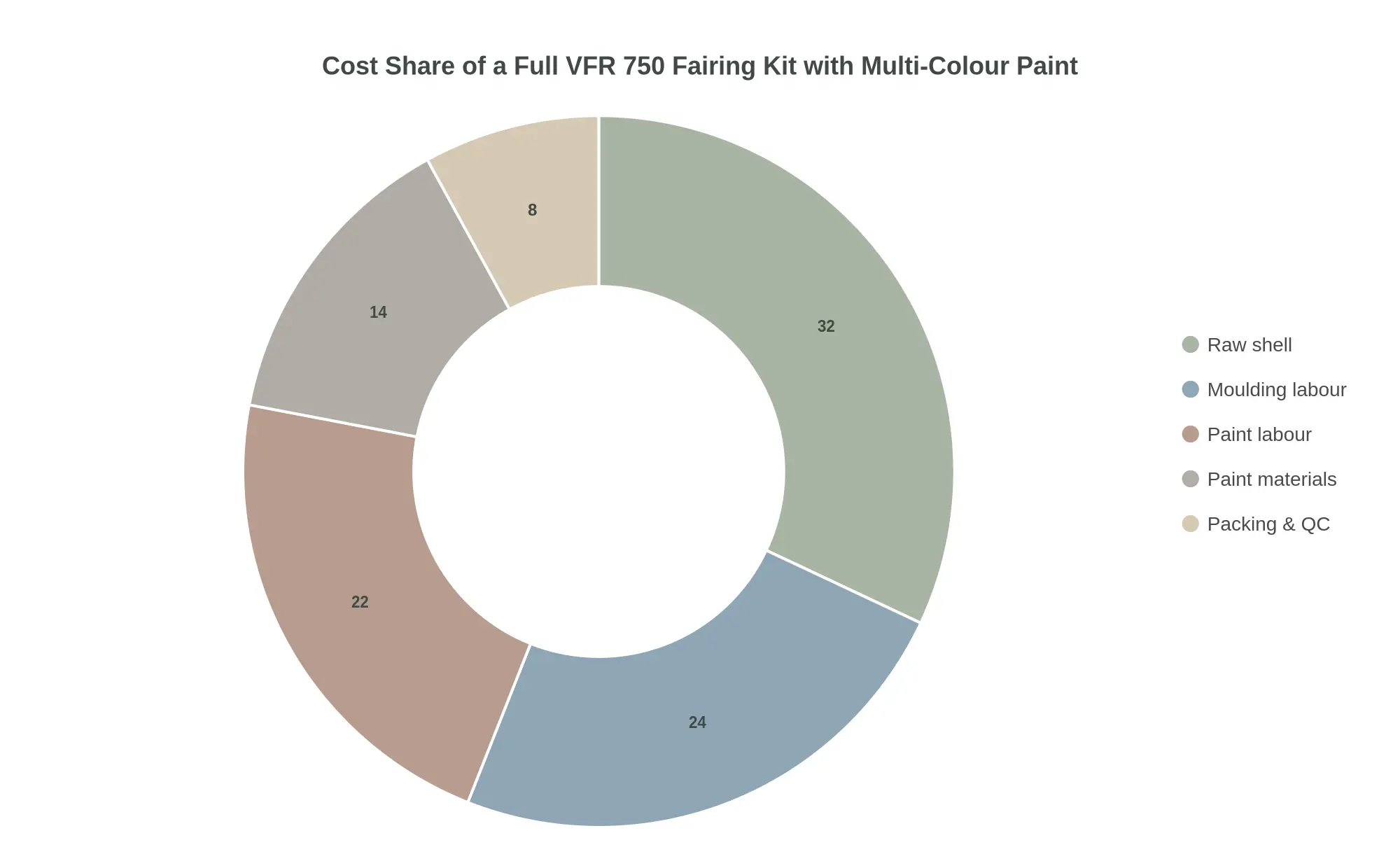
The doughnut chart splits a complete VFR 750 kit with multi-colour paint into five cost pools.
| Cost segment | Share |
|---|---|
| Raw shell material | 32% |
| Moulding and finishing labour | 24% |
| Paint labour and masking | 22% |
| Paint materials | 14% |
| Packing and quality control | 8% |
Paint materials, the line shoppers fixate on, are only 14 percent. The swing factors are panel count and paint coverage, because every extra panel and every extra colour adds hours in moulding, sanding, masking and spraying. Same panel count, six colours instead of two, and the totals separate by a wide margin. Benchmarking different builds is easier against the wider range of Honda fairings, where panel count shifts model by model.
Frequently Asked Questions
How many panels does a complete VFR 750 fairing kit include?
A full kit usually runs 12 to 18 moulded pieces: upper cowl, left and right side panels, lower belly pan, front fender, tail section, and the inner trims that tie them together, with more once brackets and hardware are counted. Counts differ between suppliers because some quote only the large painted shells, while others bundle brackets, tank covers and hardware into the same set. Check the piece list before assuming two quotes cover identical parts.
Does paint coverage or panel count change the Honda VFR 750 fairing price more?
Panel count sets the floor, since every extra moulding adds material, labour and shipping volume. Paint coverage moves the number faster once you pass a single colour, because multi-colour layouts and clear-coat layers add masking, drying and finishing time. Two more pieces are usually modest; a three-colour design can shift the Honda VFR 750 fairing price significantly.
Does a painted multi-colour set cost more to ship?
Yes, typically a little more. Painted sets need individual wrapping, foam separation and stiffer cartons to protect the finish, and multi-colour orders often contain more pieces, raising both weight and dimensional size. The gap is small next to the paint cost itself.
How do I compare quotes from different suppliers on equal terms?
Request an itemised list showing part names, panel count, paint coverage per colour, whether decals get clear-coated, and whether hardware is included. Then compare totals on that identical specification, freight and packaging included, so nothing hides in the difference.
What turnaround and support should I expect on volume orders?
Bulk production generally takes two to four weeks before dispatch, and you should receive a written schedule plus a colour proof before painting starts. At summitfairings.com, every enquiry gets a reply within six hours, so volume planning never stalls. Keep one contact for revisions to avoid version mix-ups, and check the Honda fairings range to confirm fitment first.
Conclusion: Two Numbers to Compare Before You Buy
A fairing quote comes down to two figures: panel count, which sets material, moulding and freight, and paint coverage, which sets labour and finishing. Whatever a shop calls its line items, those two numbers are what the total is made of. Put competing quotes side by side on both before you look at the bottom number. For owners weighing Honda fairings options, summitfairings.com lists more than 3,000 styles and prices 10-40% below other sites, which gives you a starting point to compare against.