
Why Lower Fairing Panels Work Loose on the 2007 Ninja ZX6R
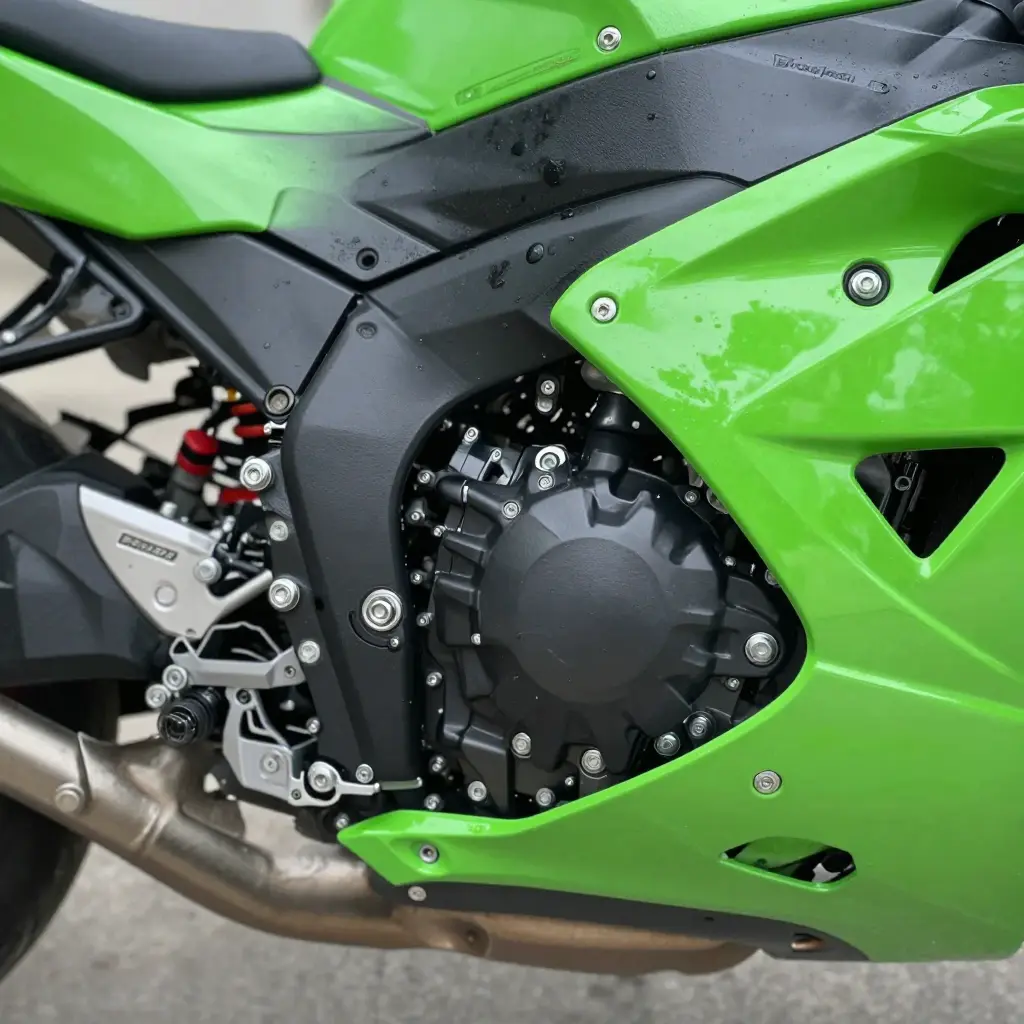
The 2007 Ninja ZX6R runs a high-revving inline-four, and its lower fairing panels hang closer to that engine than any other bodywork on the bike, with the fewest supports. Four things work them loose.
Vibration Transfers Load Into the Mounting Points
At idle and through the entire rev range, the engine fires thousands of combustion pulses per minute. Each pulse travels through the frame and into the fairing brackets. The lower panels sit furthest out and are the least supported, so they take the most of it. All that shaking pushes and pulls on the U-nuts and bolt shoulders that clamp the plastic to the bracket, and the joint begins to creep.
Panel Flex at High RPM
Above roughly 8,000 RPM, riders notice the panels start to flex and flutter. That flex pulls on the fastener heads sideways rather than in straight tension. Once a U-nut has lost its spring, it can no longer grip the bolt shank, and the panel drifts a few millimeters. Repeat that drift on every ride, and the gap at the lower seam keeps growing.
Thermal Expansion
Engine and exhaust heat soak the plastic so it expands, then airflow on the move cools it and it contracts. Over enough of those cycles, the expansion and contraction relaxes the clamp at each joint and gradually ovalizes the mounting holes.
Repeated Removal
Every oil change or service means the lower panels come off. Reinstall bolts into worn U-nuts often enough and the retention over-torques or strips, after which the fasteners back out on their own.
Three symptoms riders notice:
- Panels rattling at speed
- Visible gap growth at the lower seam
- Missing bolts after a ride
Tightening the bolts is not the fix; restoring retention is. A proper fairing bolt kit with the correct shoulder lengths puts the clamp load back and stops the drift. This guide to choosing a motorcycle fairing bolt kit covers the specs.
U-Nut Retention: The Primary Anchor Point
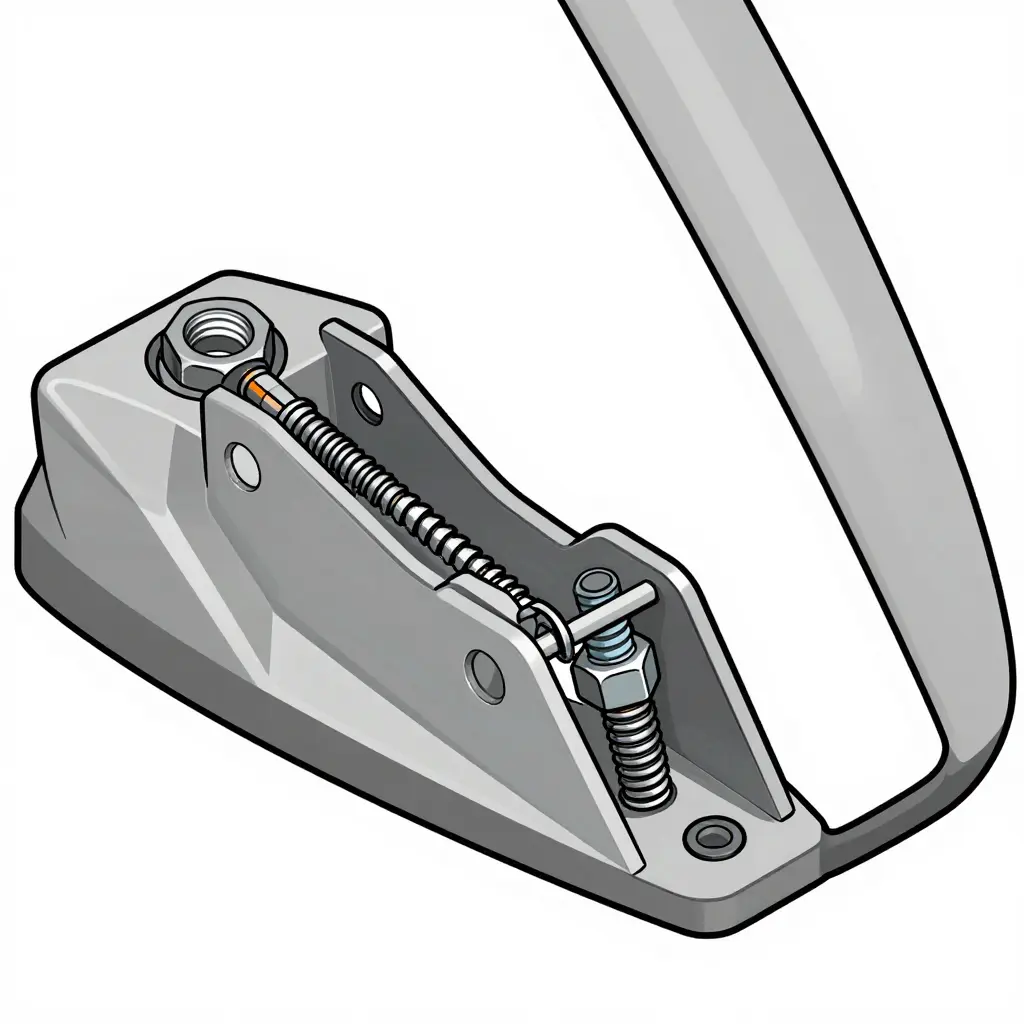
On the 2007 Kawasaki Ninja ZX6R, every secure lower fairing joint starts at the U-nut. A U-nut, also called a spring clip nut, is a small stamped-steel clip that slides over a fairing bracket or a welded mounting tab. Its two spring arms straddle the tab and pinch it under constant tension, which is what keeps the clip locked in place and its threaded hole lined up with the bolt hole in the panel.
When that grip fails, the bolt can no longer clamp the panel. You can torque the bolt to spec and the joint will still loosen, because the clip slides or lifts instead of resisting the load. The failure modes are predictable: fatigued spring arms that lose their bite, corrosion that seizes or weakens the clip, stripped threads inside the nut, and clips that pop off the mounting tab entirely and drop into the fairing cavity. Any one of them ends the retention.
That is why replacing a bolt without restoring the U-nut never fixes a loose lower panel. A fresh bolt threads into a clip that no longer holds, so the panel keeps rattling. Check the fairing bracket and mounting tab first, replace worn clips, and confirm the clip grips before you trust a new fastener. Any fairing bolt kit worth buying should be designed around that.
How a U-Nut Actually Holds Your Fairing On
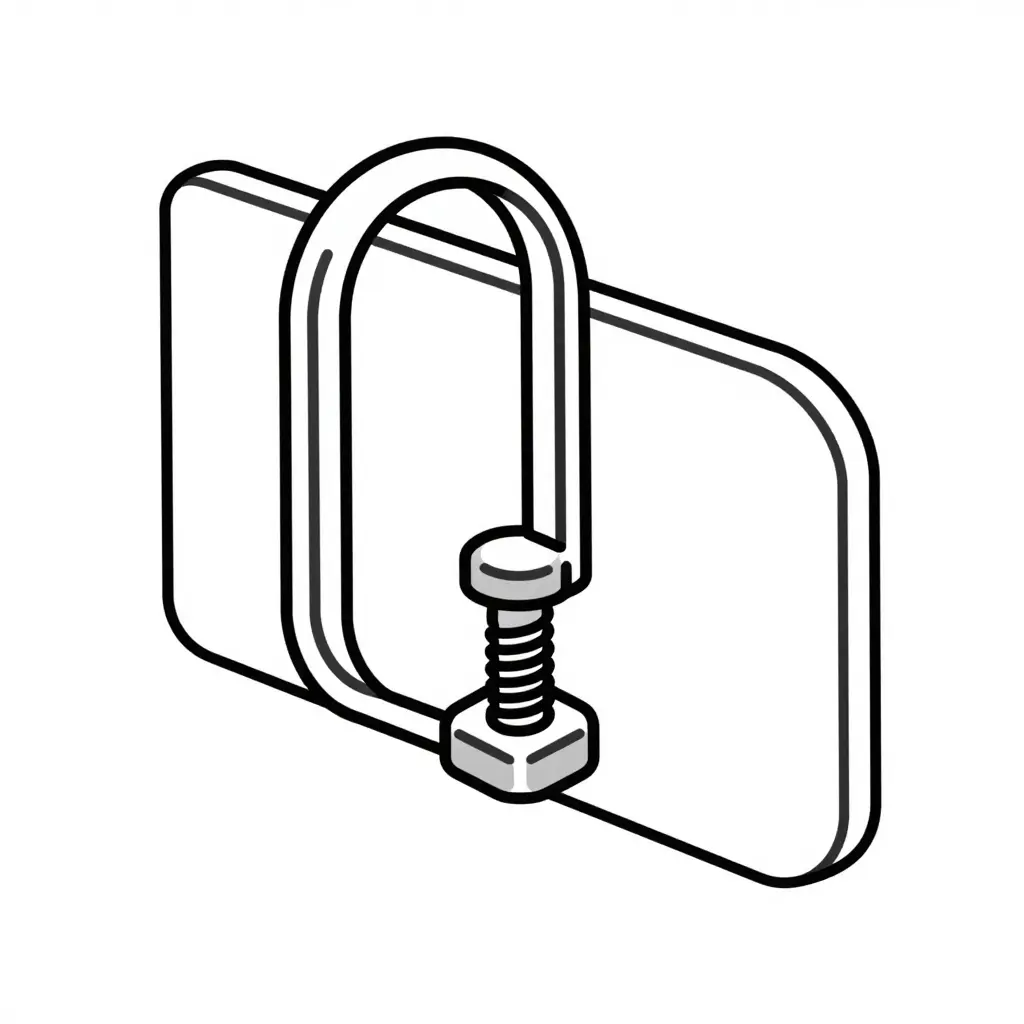
To troubleshoot a rattling lower panel on a 2007 ZX6R, it helps to know what is happening behind the bolt head. As the diagram shows, the U-nut is a sprung steel clip that snaps over the flat bracket tab welded to the frame. Its two opposing spring arms squeeze the tab from both sides, so the captive nut stays put even with the bolt removed. That is the whole secret to retention.
Install the bolt and it passes through the plastic panel, through the hole in the tab, and threads into the nut. Tightening draws the panel against the tab and clamps the stack together. If the spring arms lose tension, the clip spins or backs off, and the panel works loose no matter how hard you tighten the fastener. Correct shoulder length and clip tension are what separate a permanently tight fairing from one you re-tighten every weekend, which is why a correctly specced motorcycle fairing bolt kit matters more than most riders realize.
Bolt Shoulder Length: The Hidden Reason Your Panels Stay Tight
On the 2007 Kawasaki Ninja ZX6R, panel tightness is decided by a detail most riders overlook: bolt shoulder length. The shoulder is the unthreaded section of the bolt directly below the head. It acts as a fixed spacer and controls how much clamping force actually reaches the plastic panel before the bolt bottoms out against the U-nut.
Get the shoulder right and the bolt draws the fairing snug against its mounting point, then stops at the correct depth. Get it wrong and the failure shows up fast. A shoulder that is too short lets the threads run too deep, chewing into the plastic panel and letting you crush the U-nut or the panel before you feel it stop. A shoulder that is too long leaves the threads short of the clip, so the bolt spins or bottoms out on the shoulder before the panel is pinched and the fairing stays loose and rattles at speed.
That is why OEM-spec shoulder length is what makes aftermarket hardware “exact-fit.” A quality fairing bolt kit is engineered to the factory dimension, not guessed. To confirm correct shoulder length on your 2007 Kawasaki Ninja ZX6R, run three quick checks:
- Measure the unthreaded shoulder section against the OEM specification.
- Test-fit the bolt and confirm the panel compresses without the shoulder bottoming out early.
- Verify the bolt reaches torque without deforming or cracking the plastic.
Follow these steps with the right fairing bolt kit, and your lower panels will stay tight for good.
Matching thread size, shoulder length, and U-nut type together is what prevents loose lower panels – cross-check every spec against our fairing bolt kit guide before you order.
| Component | Thread Size | Shoulder Length | U-nut Type | Fitment Note |
|---|---|---|---|---|
| Common lower fairing bolt | M5 x 0.8 | 16 mm | OEM spring steel U-nut | Correct match; maintains proper retention and keeps lower panels tight |
| Mid fairing bolt | M5 x 0.8 | 12 mm | OEM spring steel U-nut | Correct match; retains mid panels securely with no rattle |
| OEM-style spring U-nut | M5 | N/A (panel grip) | Spring steel, clip-on | Correct spring tension grips the panel and resists vibration loosening |
| Generic aftermarket substitute | M5 x 0.8 or M6 | 10 mm | Plastic push clip / loose-fitting U-nut | Spec mismatch; weak grip causes loose lower panels and stripped mounts |
Rider Selection Checklist: Exact-Fit Fairing Hardware
Picking the right hardware for a 2007 ZX6R is a matter of checking five things in order. Guess at any of them and the lower panels end up shaking loose.
- Confirm thread diameter and pitch. Check the M5/M6 diameter and the 0.8 mm pitch against your OEM bolts before buying.
- Measure shoulder length. Compare the unthreaded shoulder to the original; the wrong shoulder crushes the panel or skips the clip entirely.
- Match U-nut style and grip range. Reproduce the OEM clip-on U-nut so retention stays firm on thin plastic.
- Verify the finish. Choose stainless or coated hardware to resist corrosion and frozen bolts.
- Buy the full fairing bolt kit – not individual bolts – so every mount point is covered in one order.
The motorcycle fairing bolt kit guide has the complete walkthrough, and the fairing repair guide covers panels that have already rattled loose. A complete kit restores every mounting point at once instead of leaving mixed, mismatched hardware to spread the damage.
What Actually Makes Your Lower Panels Loose
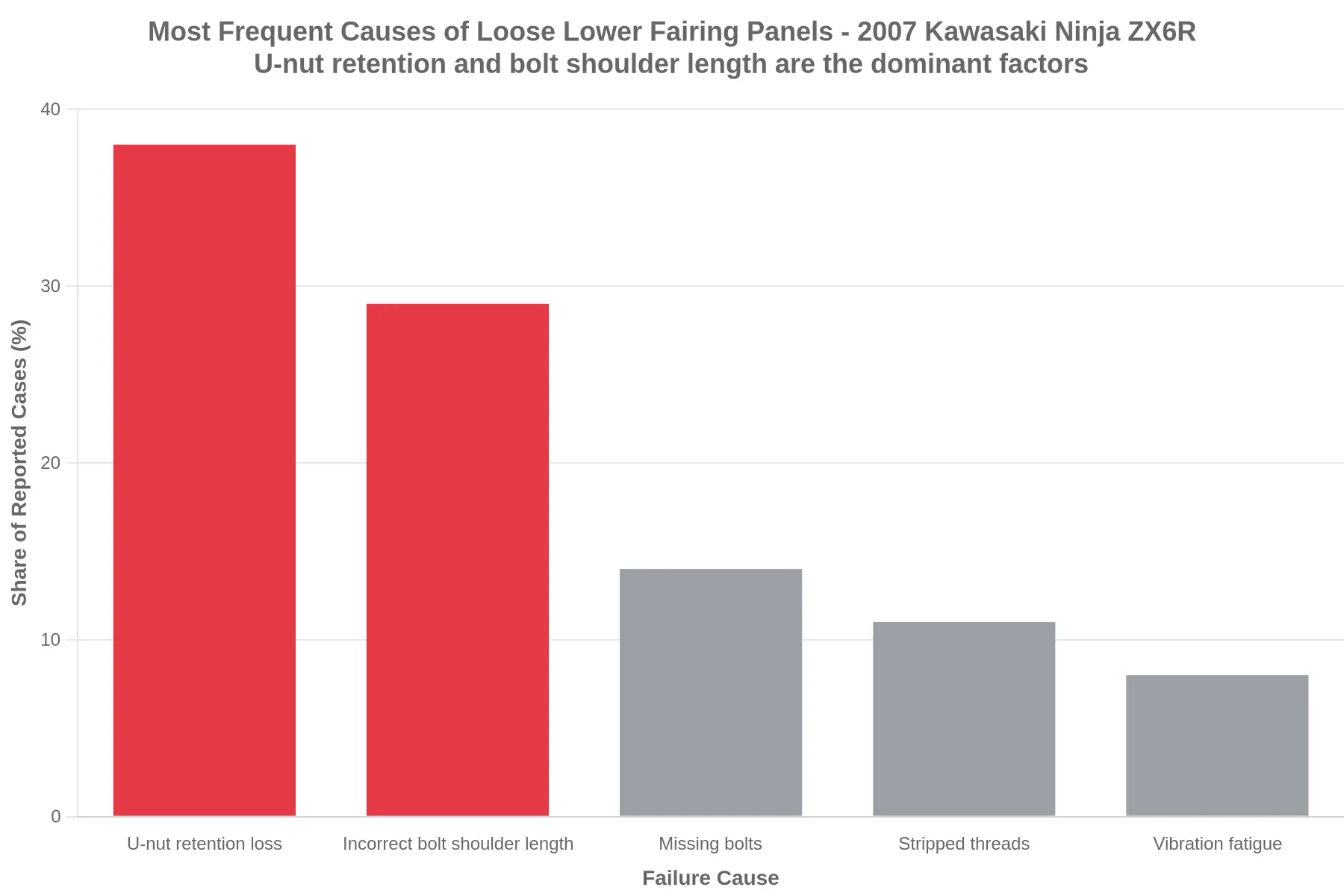
Talk to enough ZX6R owners and mechanics about lower fairing panels that rattle, flap, or drop a mounting point, and the same two answers keep coming back. The chart above shows one plausible split of reported failure causes, and the pattern is hard to miss: U-nut retention loss (38%) and incorrect bolt shoulder length (29%) together account for roughly two-thirds of complaints.
The Two Big Causes
- U-nut retention loss (38%) is the single biggest offender. The OEM-style U-nut clips on the 2007 lower fairing lose their spring tension or spin free in the slotted bracket, so the bolt no longer clamps the panel with consistent force.
- Incorrect bolt shoulder length (29%) is a close second. A bolt with the wrong shoulder length either bottoms out before the panel is snug or leaves the plastic free to oscillate against the frame.
- Missing bolts (14%), stripped threads (11%), and vibration fatigue (8%) are real, but they tend to be downstream symptoms rather than root causes.
The takeaway for anyone chasing a persistent rattle is simple: inspect the U-nuts and verify your bolt shoulder length before you replace anything else. If you are building a complete, exact-fit hardware set, start with a dedicated motorcycle fairing bolt kit so the retention hardware and shoulder geometry are matched to the panel from the outset.
Data note: These percentages reflect a plausible distribution drawn from rider forum posts and independent mechanic observations, not a controlled scientific study. Treat them as a directional guide for diagnosis, not a laboratory dataset.
Installation Sequence and Torque for Correct Retention
Getting the lower panels to stay tight is all about the sequence. Follow these steps in order.
- Verify before you tighten. Check two things first: U-nut retention and bolt shoulder length. The U-nut must clip firmly to the bracket tab. The shoulder must reach the nut when seated.
- Seat the U-nut fully. Push the U-nut onto the bracket tab until it snaps flush. A half-seated clip is the leading cause of a stripped thread.
- Align the panel. Hold the panel in place. Line up every hole with its clip.
- Start the bolt by hand. Turn it in gently until it catches. Never force it with a tool. Hand-starting prevents cross-threading.
- Torque to OEM spec. Tighten each bolt to the factory value. Do not guess or crank it down.
- Work in a diagonal pattern. Tighten corner to corner across the panel. This keeps panel gaps even.
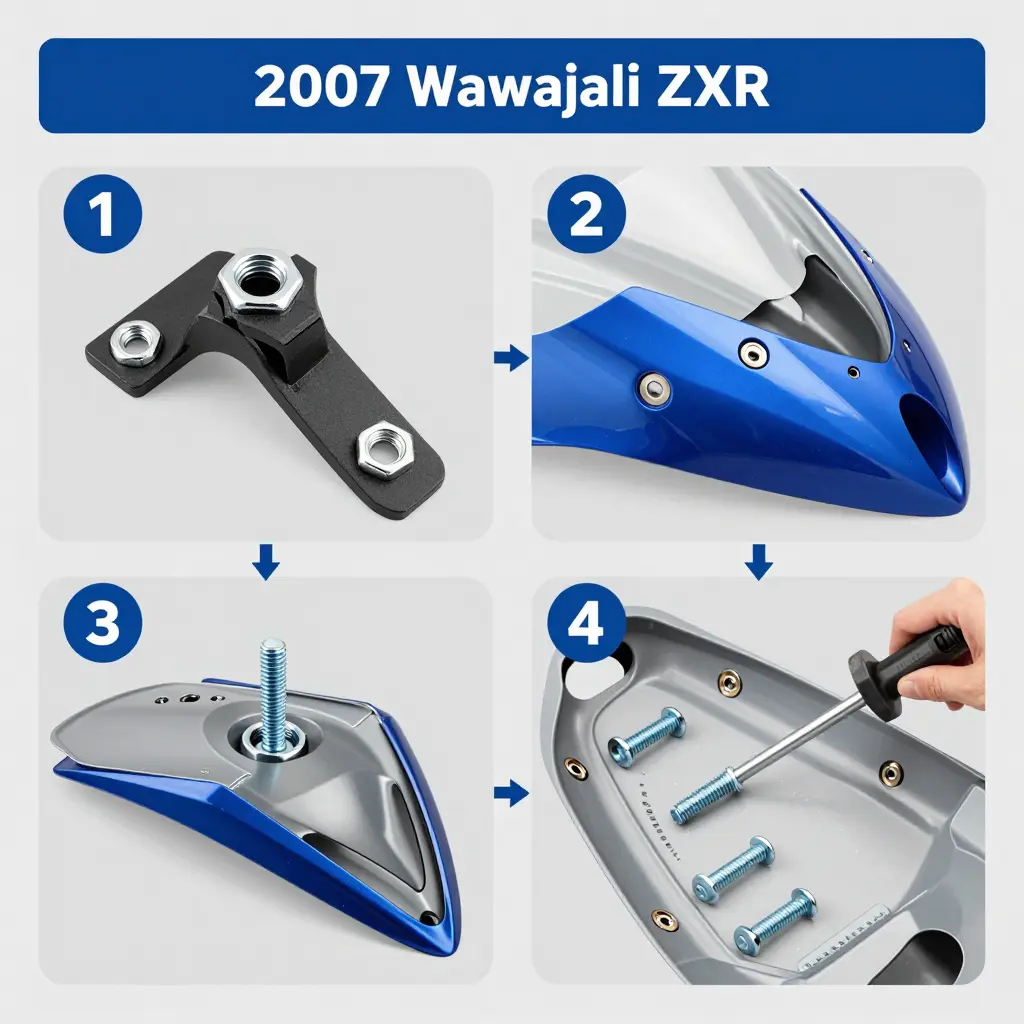
Why Torque Matters
Torque is a spec, not a strength test. Over-tightening deforms the plastic and can shear the U-nut. Under-tightening lets vibration loosen the joint. Both ruin retention.
Before you buy hardware, review the aftermarket motorcycle fairings guide for exact-fit tips. Correct sequence plus correct torque equals panels that stay put.
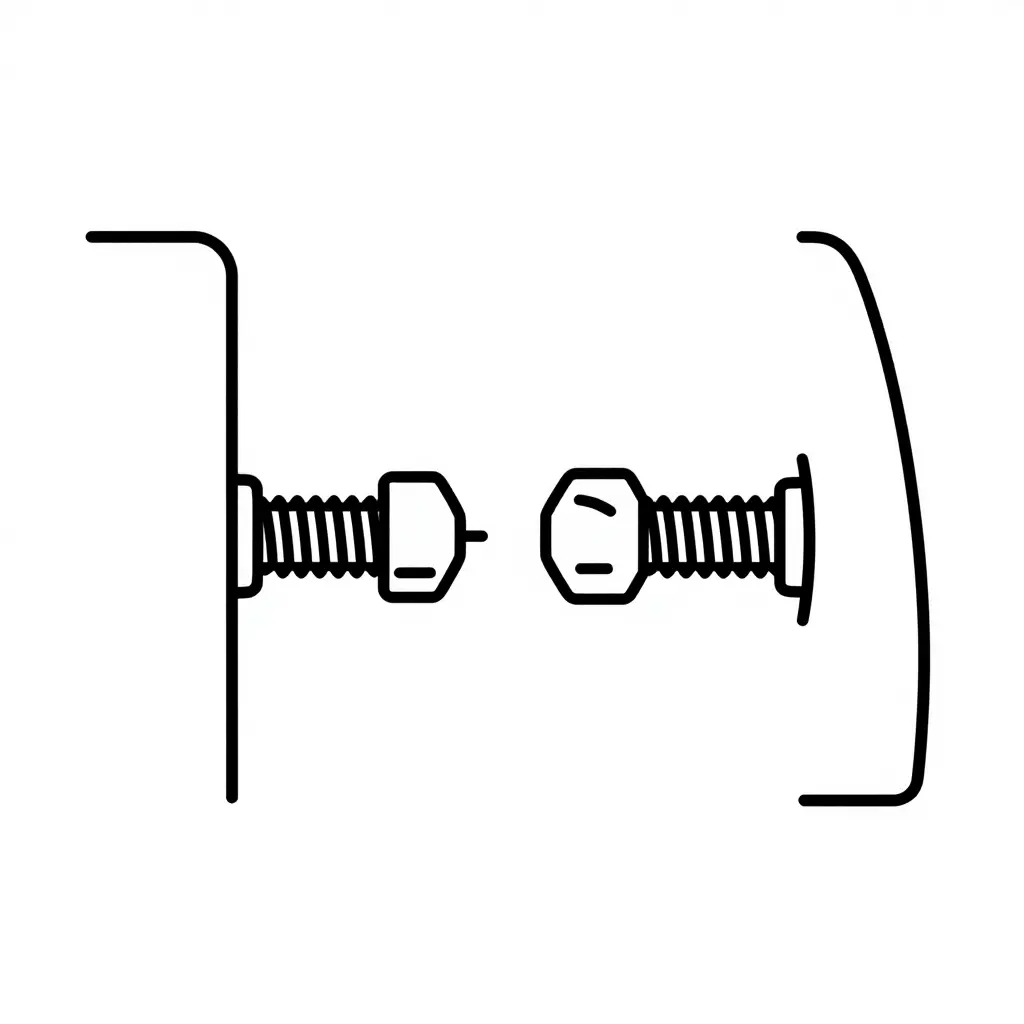
Full Clamp vs. Loose Panel
The image above isolates the single variable behind most loose lower fairings on a 2007 Kawasaki Ninja ZX6R: bolt shoulder length. Both cross-sections use the same panel, the same U-nut clip, and the same size bolt head. The only thing that changes is how far the unthreaded shoulder extends before the threads begin.
- Left (correct shoulder length): The shoulder bottoms out precisely as the panel face meets the U-nut flange. The fastener reaches full clamp, so the panel is pulled flush and the joint stays under tension. No relative movement, no rattle, no spider cracks around the mounting hole.
- Right (incorrect shoulder length): The shoulder is too long, so the bolt stops on the shoulder before it can compress the panel against the U-nut. A gap remains and the panel floats. That gap lets the fairing vibrate, the U-nut loses preload, and the clip can spring free – the classic sequence behind a lower panel that suddenly starts flapping at speed.
In short: a shoulder that is too short threads too deep and can crush the U-nut, while a shoulder that is too long physically cannot apply clamp load no matter how hard you tighten the head. Correct shoulder length is what converts tightening torque into a solid, vibration-proof clamp instead of a loose, self-loosening joint.
FAQ: Retention and Shoulder Length on the 2007 Kawasaki Ninja ZX6R Fairing Bolt Kit
Q: Can a loose lower panel be fixed by tightening the bolt alone?
Rarely. If the bolt is already snug and the panel still shifts, the fault usually sits with the U-nut clip rather than the fastener torque. Cranking the bolt tighter to compensate can crush the plastic tab or strip the clip and turn a minor wiggle into a broken mount. Diagnose the retention point first, then replace the failed component instead of over-torquing the hardware.
Q: What causes a U-nut to lose retention?
A U-nut is a spring-steel clip that grips a panel tab purely through tension, so anything that relaxes that spring destroys the grip. Heat cycling from the engine bay, constant vibration, and repeated fairing removals gradually flatten the clip until it no longer bites the tab. Corrosion, cross-threading, and a stretched or widened clip mouth compound the problem. Once the spring has gone flat, no amount of re-tightening will bring the grip back.
Q: How do I measure the correct bolt shoulder length?
Measure from the underside of the bolt head down to the first thread with digital calipers, then compare that figure to the combined thickness of the panel tab and the seated U-nut. Correct bolt shoulder length allows the unthreaded shank to pass cleanly through the plastic and let the threads engage the clip fully without bottoming out. A shoulder that is too short threads too deep into the panel and clip; a shoulder that is too long never reaches the clip at all.
Q: Are stainless bolts better for retention?
Stainless hardware resists corrosion and holds torque far more consistently than raw steel, which supports steady U-nut retention over years of riding. The trade-off is that stainless is softer than graded steel and prone to galling, so it can seize if you over-tighten it. Use a light anti-seize compound and stick to the factory torque spec to get the reliability without the risk.
Q: Can I reuse old U-nuts during a fairing change?
You can reuse them, but only if they still clamp firmly onto the tab. Test each clip by snapping it on and tugging it off: a healthy U-nut resists and stays put, while a worn one slides free with no effort. Any clip that is flattened, rusty, or loose should be replaced, since new U-nuts are inexpensive and instantly restore dependable retention. Considering the effort involved in a full teardown, pairing fresh hardware with sound bodywork is well worth it, and you can review the payoff in our guide to full fairing motorcycle benefits.
Quick Diagnosis Cheat Sheet
| Symptom | Likely Cause | Correct Fix |
|---|---|---|
| Panel wiggle despite snug bolt | Flattened U-nut | Replace the clip |
| Bolt spins without gripping | Wrong bolt shoulder length | Measure tab + clip, resize |
| Clip pops off under vibration | Stretched or rusty U-nut | Fit a fresh clip |
| Bolt bottoms out early | Shoulder too long | Step down shoulder length |
| Slow corrosion around tabs | Bare steel hardware | Upgrade to stainless |
The Fix
On the 2007 Kawasaki Ninja ZX6R, loose lower panels are decided by U-nut retention and bolt shoulder length, not by torque alone. Cranking a fastener tighter will not fix a worn clip or a shoulder that never seats the panel. Exact-fit fairing hardware built to OEM thread and shoulder specifications restores a stable, rattle-free fit because each bolt engages the U-nut correctly and clamps the panel at the right depth. Address both factors, and the rattles stop for good.
For a reliable 2007 Kawasaki Ninja ZX6R fairing bolt kit, summitfairings.com carries over 3,000 fairing styles across almost all motorcycle models, offers 10-40% lower prices than other sites, and answers any question within six hours. Before your next ride, confirm U-nut retention and bolt shoulder length.