

Why Superseded Part Numbers Decide the Order Before You Buy
Yamaha changes part numbers when tooling moves, a supplier changes, a paint code is retired, or several pieces get folded into one assembly. Each new number is logged against the one it replaces, which is why the number in an old dealer catalog, on a used side panel, or in a workshop note often is not what ships today. For a shop ordering an OEM 2006 Yamaha V Star 650 fairing, the revision trail matters more than the number in your hand.
A superseded number points to a replacement, not to a discontinued part. The counter or the website should pull the newer, live item, which normally fits the same mounting points and brackets. Finish is the part to check: a new suffix can mean a different paint code, and two panels bought a year apart may not match in daylight.

What each number in your hand actually means
| Number you are holding | What it signals | Action before ordering |
|---|---|---|
| Active, current number | Orderable as listed | Confirm color code and left/right side |
| Superseded number | A valid replacement exists | Cross-reference to the newer number |
| Old number with no successor | No OEM supply through that path | Source used or aftermarket equivalents |
Skipping the check costs money. A wrong-number panel usually goes back at the buyer’s freight expense, the bike sits on a lift while the replacement is sorted, and the margin on the job goes with it. Shops that verify first keep the price they quoted.
The V Star 650 makes this worth the trouble. Paint codes and brackets changed across model years, and one front panel can sit at the end of three or four numbers. These cruisers use a windshield and trim rather than a full fairing, and the Custom came without a windshield, so listings use “fairing” loosely for parts Yamaha files under windshield, cowl, or trim. Cross-referencing tells you when a part has been dropped, which is the point to price an aftermarket set such as those in our custom fairings collection rather than quote a part Yamaha no longer makes.
How Yamaha Supersedes OEM 2006 Yamaha V Star 650 Fairing Part Numbers
Look up an OEM 2006 Yamaha V Star 650 fairing number today and the figure on the fiche may not be the number that ships. Yamaha keeps its parts catalog current, retiring numbers and replacing them with newer ones that are meant to be interchangeable. The trade calls that a supersession. Yamaha leaves the old numbers searchable so dealers, resellers, and repair shops can trace an old listing to the current item. Our replacement bodywork catalog is one place to see what is currently stocked before you chase a legacy number.
Supplier or tooling change
A supplier move or a rebuilt mold is one trigger. When Yamaha shifts a panel to a different supplier, or a worn mold is replaced, the geometry may be re-validated and issued under a new number even though the part still bolts on the same way. The old number is flagged as superseded, and most dealer systems route an order for it to the current number.
Material and finish update
Sometimes the change is in the material rather than the fit. A different resin, primer system, or paint process usually brings a new number and a higher revision code. The panel still fits, but the finish behind it is not the same.
Color code revision
Color gets its own category on cruisers like the V Star 650. Yamaha retires paint codes, adjusts metallic flake, or renames a shade for a new model year, and the change shows up in the last characters of the number. If you are matching paint to a bike you already own, check the code on the build record or through a dealer VIN lookup rather than trusting a photo or a listing title.
Consolidation into a service assembly
Yamaha also folds several panels into one service assembly when the separate pieces become impractical to stock. Instead of ordering a bracket, a trim strip, and a side cover one at a time, you order the assembly that contains all three, and the individual numbers are marked superseded by the kit.
Supersession versus discontinuation
A supersession gives you a way forward when it is published: the old number points to a new, orderable number. A discontinuation does not. The part has been dropped and the listing ends. Buyers who confuse the two can end up waiting on backorders that never clear.
Check the newest number and its current revision code before you commit to a purchase order.
Superseded Part Number Reference Table: 2006 Yamaha V Star 650 Fairing
Note: The table below lists what to check, not numbers to copy. It covers the front-bodywork categories that come up most often on a 2006 V Star 650 and what tends to change. Pull the current number and suffix from a dealer electronic parts catalog (EPC) before ordering; a wrong color suffix is the most common reason a “correct” panel arrives in the wrong shade.
| Original OEM Number | Current Superseded Number | Panel or Component | Model-Year Coverage | What Changed |
|---|---|---|---|---|
| Verify with dealer EPC | Verify with dealer EPC | Front bodywork / windshield surround (often sold as a fairing) | 2006 XVS650 family (Custom, Classic, Silverado) – confirm in EPC | Usually superseded with a color suffix change; check that the new number still lists your factory paint code |
| Verify with dealer EPC | Verify with dealer EPC | Inner trim / instrument surround (where fitted) | 2006 XVS650 family – verify | Inner plastics often consolidate across years, and the mounting bosses can differ from the original casting |
| Verify with dealer EPC | Verify with dealer EPC | Left side panel (electrical / battery cover) | 2006 XVS650 family – verify | Most likely a suffix change (color or decal set), not a shape change |
| Verify with dealer EPC | Verify with dealer EPC | Right side panel | 2006 XVS650 family – verify | Frequently sold as a painted assembly; the superseded number may bundle a new emblem or grommet set |
| Verify with dealer EPC | Verify with dealer EPC | Lower cowl / chin spoiler (where fitted) | 2006 XVS650 – market-dependent fitment, verify | Accessory-market vs. factory fitment splits here; confirm the current number is the factory-issue version and not an accessory-only code |
| Verify with dealer EPC | Verify with dealer EPC | Tank cover / console shroud | 2006 XVS650 family – verify | Cover assemblies are commonly superseded with a revised gasket or mounting clip included |
| Verify with dealer EPC | Verify with dealer EPC | Mounting hardware kit / cowl bracket set | 2006 XVS650 family – verify | Hardware gets superseded often: bolts and clips get replated, re-bagged, or consolidated into one kit number |
| Verify with dealer EPC | Verify with dealer EPC | Windshield / windscreen and trim strip | 2006 XVS650 – verify height and hole pattern | Supersessions here often reflect a supplier change; compare mounting hole spacing before ordering |
| Verify with dealer EPC | Verify with dealer EPC | Emblem and decal set per panel | 2006 XVS650, color-code specific | Graphics-only changes are common on superseded numbers and are easy to miss when you order by panel name alone |
How to Read a Supersession Entry Without Getting Burned
Three things in a supersession entry can change independently, and they do not always change together:
- The base number: the panel itself. A genuine base-number change usually signals a shape, tooling, or fitment revision, so check the old bracket against the new panel.
- The color code suffix: the paint, and where a lot of ordering errors start. A superseded suffix can map an old factory color to a newer formula, so two panels bought a year apart may not match in daylight.
- The catalog description: whether the number buys one panel, a painted pair, or panel plus clips. A kit that used to be five line items is often one now, which can double your order if you buy by habit.
A Practical Verification Workflow
- Pull the EPC diagram for your exact model code and confirm the callout number. The same panel name appears on several diagrams across the V Star line.
- Ask the dealer counter for the supersession chain, not just the live number. Seeing every step tells you whether the panel was re-tooled or re-colored.
- Photograph the back of your existing panel and any stamped or molded numbers before you order, so you have a physical cross-check when the box arrives.
- Order hardware kits with the panel, never after it. Brackets, grommets, and shoulder bolts are the parts that go out of stock between supersessions.
When you weigh OEM plastic against a set of custom aftermarket fairings, match by model code and mounting pattern first, then color. Check the number against the catalog version you are actually reading, not a printout from last year.
Where to Read the Supersession Trail Before Ordering
Start with the dealer’s electronic parts catalog. Dealers work from Yamaha’s live database, so the counter usually has the newest number. A clerk can key in your VIN and pull the current number and the chain of superseded part numbers behind the original. The catalog can lag for a few days after a new bulletin, before the sync runs.
Printed microfiche and paper parts manuals still help with early-production bikes because they show the numbers that were valid when the machine was built. They are good for original fitment and assembly diagrams, but they never update, so a printed figure may have been replaced two or three times since. Use them as history.
Manufacturer parts bulletins are the paper trail, and they usually reach dealers before the catalog catches up. They give effective dates, VIN breakpoints, and the reason for a change, which together show which units a revision covers. Access is the problem: bulletins are rarely public, so you usually need a dealer to pull the PDF.
Supplier and aftermarket catalogs help you spot equivalents, but their cross-references are often incomplete or mapped to whichever part they want to sell. Packaging and invoice labels from earlier purchases are an underrated check: they confirm what you received last time. They show one number, not the chain behind it.
| Source | Reliable for | Where it lags |
|---|---|---|
| Dealer electronic catalog | Live current numbers, VIN lookup, full chains | Sync delay after new bulletins |
| Printed microfiche and manuals | Original fitment, assembly diagrams, build-year accuracy | Frozen in time, never updated |
| Manufacturer parts bulletins | Effective dates, VIN breakpoints, reason for change | Not public, dealer access required |
| Supplier catalogs | Cross-reference leads to equivalents | Inconsistent, sales-driven mapping |
| Packaging and invoice labels | Confirming what you received previously | Shows one number, not the chain |
When you cross-check an OEM 2006 Yamaha V Star 650 fairing across these sources, read the Yamaha parts catalog last and trust it most for the final number. If you are still sorting categories, our uncategorized fairing collection is a place to start. Bring the confirmed number to the counter and the conversation gets short.
The diagram below strips out the part numbers and shows the shape of a supersession trail: one starting number, a branch where a running revision appears, and a merge where everything folds back into one service number.

Read it left to right the way you would read a build sheet. The branch is where mix-ups happen: the number splits into an original casting and its revision, and both stay orderable for a while. The merge is what you want on the invoice, one live service number that supersedes everything behind it.
Step-by-Step Procedure for Reading Superseded Numbers
Run this sequence before your purchasing or workshop team commits to a single panel for an OEM 2006 Yamaha V Star 650 fairing. It checks superseded part numbers and fitment against the current OEM record, not a stale invoice, an old spreadsheet, or a forum thread.
Identify the panel by position. Write down where it sits and what it does, in your own shop’s naming: left upper, right lower, inner dash. Treat the number on file as a historical reference, since it may point to a discontinued or renumbered item.
Pull the current number from the EPC. Select the exact model year and variant, go to the same position, and record the number, its diagram reference code, and the date you checked it.
Run the supersession lookup. Enter the number and write down every entry in the chain, from the original to the active one. Flag anything marked discontinued without replacement before you price it.
Compare finish codes. Check the suffix on each number in the chain, since the same panel shape can carry a different paint code. Confirm the suffix matches the job and note any code replaced by a newer finish.
Check the hardware. Look up the brackets, grommets, and retaining clips listed with the panel instead of assuming the old fasteners will transfer. Record each clip number so the workshop gets a complete set.
Check the invoice or packing list before you accept delivery. If the number does not match what you verified, refuse the shipment or return it, and log the discrepancy.
Working through the six steps keeps superseded part numbers and fitment verification tied to a documented source. If you need a starting point, browse our fairing collections before requesting a quote.
What a Stale Number Costs You
The chart compares the same 2006 Yamaha V Star 650 fairing panel ordered two ways: against an outdated number still floating around in old parts lists, and against the verified superseded number that ships today.
The panel price barely moves: $412 on the stale path, $389 on the verified one. Return freight, restocking fees, and labor rework are what turn that $412 into a $646 line item, before you count the week the bike sat waiting.
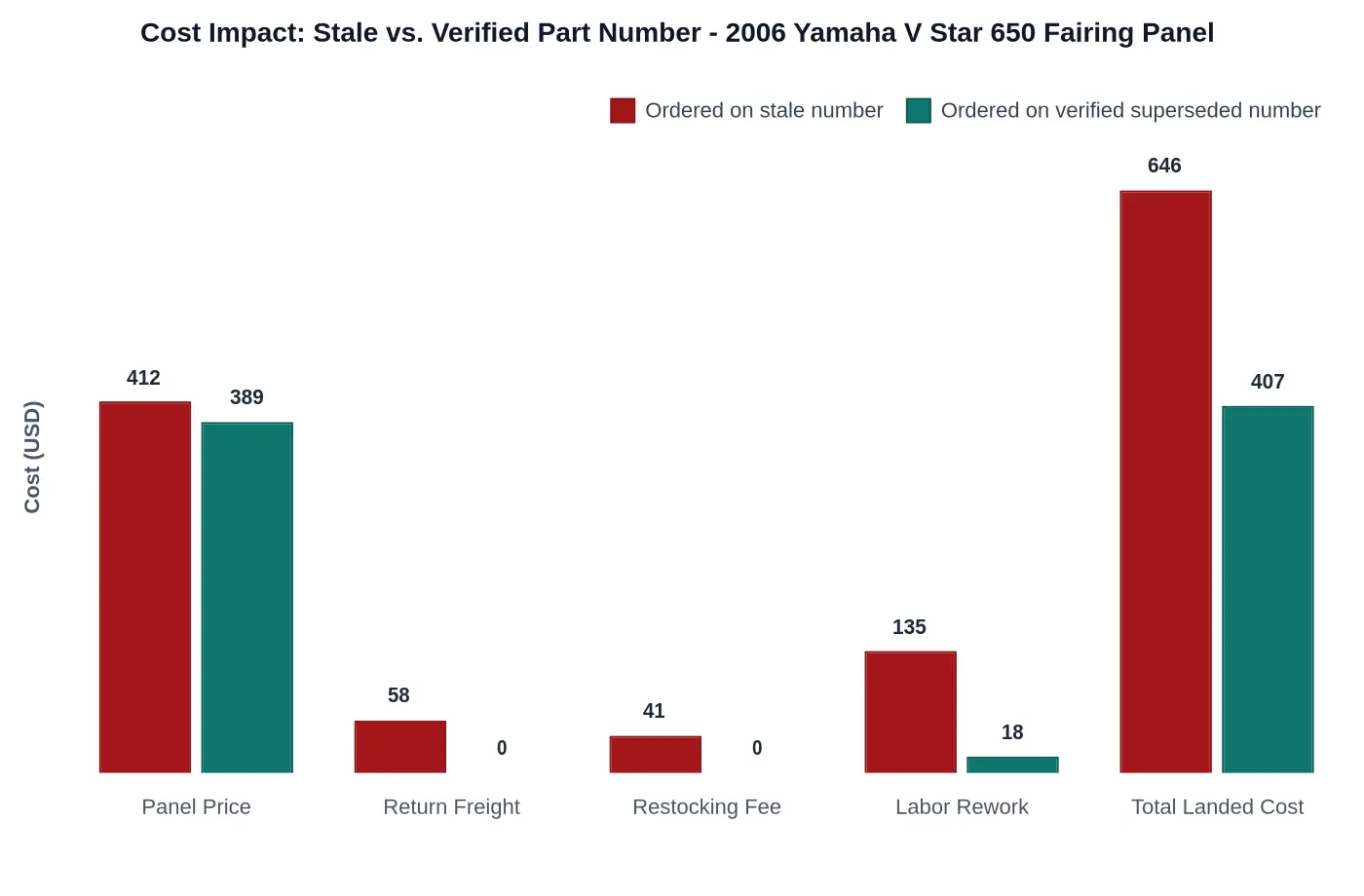
Illustrative estimates in USD; confirm current pricing and supersession data with your dealer before ordering.
Reading the bars
- Panel price: the smallest gap in the chart. The sticker is not where the money goes.
- Return freight: a wrong-fit panel is a bulky, fragile return, and you often pay to send it back.
- Restocking fee: often charged once an order has been opened and shipped.
- Labor rework: test-fitting, re-boxing, re-ordering, and re-booking the bay.
- Total landed cost: the number that should drive the decision, roughly 59% higher than the verified path.
While you sort out the number, our custom fairing collections are one place to compare a replacement against a repair.
Red Flags That a Part Number Is Stale or Mismatched
Scan the listing for these signs before you commit to a bulk order. One is worth a second look; two together are a reason to pause.
- The number returns nothing in the catalog. If a number you found six months ago now gives a blank page or a redirect, it has probably been retired. The seller may be working from an old screenshot.
- The finish code does not match. A suffix that disagrees with the trim code on your build record gets you a panel that fits and still looks wrong.
- A superseded note with no successor. Listings often mention superseded part numbers and forget to name the replacement, which leaves you with a dead end.
- The price moved sharply. A jump or drop of 30 percent or more between quotes can signal a swapped vendor, a discontinued run, or a number pulled from a different model year.
- The mounting points are described differently. Different tab counts, grommet locations, or bolt spacing from your original suggest the listing was recycled from another bike.
- The fitment claim covers too many years. OEM front bodywork rarely spans a decade without a mid-cycle change, so a ten-year claim is worth questioning.
- The seller cannot confirm a VIN or color code when asked directly.
When two or more of these show up, treat the number as unverified. Confirm the current number and finish code with a dealer or a VIN lookup, then compare the result with our full fairing catalog before you pay.
Parts catalogs show the front bodywork as a stack of separate panels, not as a finished motorcycle. The schematic below strips away the bike and leaves the shapes, their positions, and the connector lines that stand for attachment points.

Use it as a checklist when you open the fiche: any shape in the diagram with no matching line item on your quote is a panel you have not priced. If you are replacing several pieces at once, compare complete painted fairing sets before buying them one by one.
Model Variant and Fitment: Why One 2006 V Star 650 Fairing Is Really Three Parts
Same model year, same 649cc V-twin, three different configurations. Ordering an OEM 2006 Yamaha V Star 650 fairing panel by year alone gets you into trouble here. The Custom, Classic, and Silverado came from the same line, but each reached the dealer with different trim, hardware, and assembly steps, and the catalog keeps those differences separate.
Finish differences
Paint and trim codes change the look and the price. The Custom usually came in simpler solid or two-tone schemes; Classic and Silverado panels often carried more involved finishes and chrome or color-matched trim. The finish code sits at the end of the part number, so a panel that is right in every way except the suffix is still wrong for your bike.
Mounting bracket differences
Brackets cause more fitment failures than plastic does. Windshield stays differ in length, angle, and attachment points between variants, and the subframe around the headlight will take a stay designed for one configuration and not another. A Custom that never shipped with touring hardware has less to bolt to than a Silverado built for wind protection.
- Custom: the leanest setup, with fewer mounting points and little factory bodywork, so brackets often come from the aftermarket.
- Classic: adds touring hardware such as a windshield and bags, which usually means longer stays and an extra bracket set.
- Silverado: the most heavily equipped, with the most mounting interfaces to line up before a panel goes on.
Assembly differences
A panel can bolt up and still not match the assembly around it. Pre-drilled holes for trim, wiring for accessory lights, and the order in which pieces stack can vary between variants and between nearby model years. If you order the shell and assume your old hardware carries over, a two-hour job turns into a two-week return.
| Configuration | Typical finish and trim | Bracket and mounting notes | Assembly notes |
|---|---|---|---|
| Custom | Simple solid or two-tone, less trim | Fewer stays, lighter sub-frame hardware | Simplest stack-up, fewest holes |
| Classic | Richer finish with trim inserts | Longer stays to carry a windshield | Extra fasteners for touring parts |
| Silverado | Top-tier finish plus chrome accents | Most mounting points and interfaces | Most layers and wiring to route |
How variant coding shows up in the part number
Yamaha numbers usually follow a four-block pattern: a three-character model code, a five-digit component code, a two-digit design revision, and a two-character color or finish suffix. The model code usually changes between Custom, Classic, and Silverado; the suffix moves with paint. When a part is superseded, the revision or suffix often changes, and sometimes the base number does too. Compare all four blocks.
The short answer for buyers
Run fitment verification against your VIN or exact model code before the order ships, and read the whole number, not just the first block. If you are also weighing aftermarket options for Yamaha V Star 650 accessories, explore custom fairing options built around your variant, and use the wider fairing catalog for cross-references before you commit.
Frequently Asked Questions
Is a superseded number the same part as the number I already have?
Usually. A supersession means Yamaha has replaced the old number with one it still supplies, and in most cases the part is interchangeable. What can change is the finish code, the supplier, or the contents of a kit, so check the suffix and the parts list before you drop the new number into an order sheet. Fitment is normally unchanged; color is the item to confirm.
Can I still order using the old part number?
Not reliably. Once a supersession is loaded, most dealer systems will not accept the retired number: the line comes back invalid or gets rewritten to the current one. Confirm the active number before you commit; ordering an OEM 2006 Yamaha V Star 650 fairing panel against a dead number is an easy way to lose a week to cancellations.
How long does a supersession stay valid?
From the day it is published until Yamaha retires the replacement. On a long-running model like the V Star 650 that can be years. Treat a chain as current only for the catalog revision you are reading, and re-check it when you restock. Superseded numbers get superseded again; two-step chains are common on bodywork.
Are aftermarket panels matched to current numbers or the old ones?
It depends on the seller. Many aftermarket panels are listed by year, model, and mounting pattern rather than by OEM number, and the cross-reference in the listing may point to either the old number or the current one. Match the year, model code, and mounting pattern first, then use the OEM number as a confirmation. Ordering by an old number alone leaves you guessing which mold you receive.
What do I do when the catalog shows no replacement at all?
That usually means the piece is discontinued with no successor, so ordering it again will not help. Look for a full assembly number or a painted set that still includes the part, and ask a supplier to trace it in their system. If nothing turns up, browse replacement fairing collections for a molded equivalent that fits the same mounting points.
Our support team answers supplier questions within six hours.
Pre-Order Verification Checklist for Your 2006 Yamaha V Star 650 Fairing
Accuracy on bodywork for a discontinued model comes from documentation. Each item below is something a buyer can confirm before paying, and each one closes a gap between the listing and the bike in the garage.
- Current part number confirmed against the latest catalog revision, rather than the number printed on an older parts diagram.
- Factory color code matched to the model-year paint designation, including any mid-production variation.
- Panel coverage verified: the set includes every piece the listing describes.
- Superseded numbers recorded in writing, with the original numbers they replaced and how they map to the order.
- Fitment details checked against the bike’s VIN and any accessories already mounted on the frame.
Our catalog lists more than 3,000 styles across almost all motorcycle models, priced 10 to 40 percent below comparable sites, which makes side-by-side comparison practical. For model-specific listings and finish choices, browse the custom fairings collection. The support team also confirms part-number matches, so an order can be tied to the correct revision before payment.